A Spanish Politician with a Conscience

I wanted to share the following article with you. Pilar Rahola is a Spanish politician, journalist and activist and member of the far left. Her articles are published in Spain and throughout some of the most important newspapers in Latin America . Here she addresses pro-Palestinian demonstrations:

Why don’t we see demonstrations against Islamic dictatorships in London , Paris , and Barcelona ?

Or demonstrations against the Burmese dictatorship?

Why aren’t there demonstrations against the enslavement of millions of women who live without any legal protection?

Why aren’t there demonstrations against the use of children as human bombs where there is conflict with Islam?

Why has there been no leadership in support of the victims of Islamic dictatorship in Sudan ?

Why is there never any outrage against the acts of terrorism committed against Israel ?

Why is there no outcry by the European left against Islamic fanaticism?

Why don’t they defend Israel ’s right to exist?

Why confuse support of the Palestinian cause with the defense of Palestinian terrorism?

And finally, the million dollar question: Why is the left in Europe and around the world obsessed with the two most solid democracies, the United States and Israel, and not with the worst dictatorships on the planet? The two most solid democracies, who have suffered the bloodiest attacks of terrorism and the left doesn’t care.

And then, to the concept of freedom. In every pro Palestinian European forum I hear the left yelling with fervor: “We want freedom for the people!”

Not true. They are never concerned with freedom for the people of Syria or Yemen or Iran or Sudan , or other such nations. And they are never preoccupied when Hamas destroys freedom for the Palestinians. They are only concerned with using the concept of Palestinian freedom as a weapon against Israeli freedom. The resulting consequence of these ideological pathologies is the manipulation of the press.

The international press does major damage when reporting on the question of the Israeli-Palestinian issue. On this topic they don’t inform, they propagandize.

When reporting about Israel , the majority of journalists forget the reporter code of ethics. And so, any Israeli act of self-defense becomes a massacre, and any confrontation, genocide. So many stupid things have been written about Israel , that there aren’t any accusations left to level against her.

At the same time, this press never discusses Syrian and Iranian interference in propagating violence against Israel ; the indoctrination of children and the corruption of the Palestinians. And when reporting about victims, every Palestinian casualty is reported as tragedy and every Israeli victim is camouflaged, hidden or reported about with disdain.

And let me add on the topic of the Spanish left. Many are the examples that illustrate the anti-Americanism and anti-Israeli sentiments that define the Spanish left. For example, one of the leftist parties in Spain has just expelled one of its members for creating a pro-Israel website. I quote from the expulsion document: “Our friends are the people of Iran , Libya and Venezuela , oppressed by imperialism, and not a Nazi state like Israel .”
Continue Reading


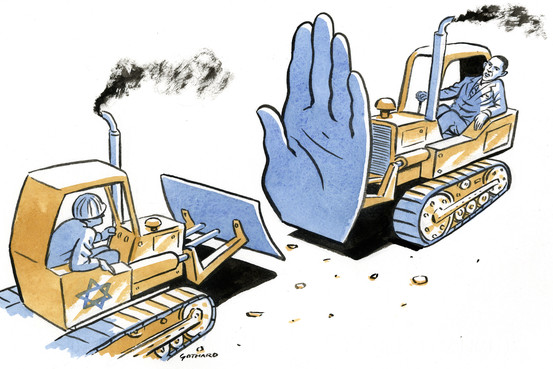
Obama’s Myopic View of Jerusalem

  • The Wall Street Journal

  • OPINION
  • APRIL 28, 2010

Obama’s Jerusalem Stonewall

Demanding a construction freeze in the capital reverses decades of U.S. policy.

By MORTIMER ZUCKERMAN

Thanks to a deadlock engineered by the U.S. government, the Middle East peace process is stalled. President Obama began this stalemate last year when he called for a settlement freeze, and he escalates it now with a major change of American policy regarding Jerusalem.

The president seeks to prohibit Israel from any construction in its capital, in particular in a Jewish suburb of East Jerusalem called Ramat Shlomo. This, despite the fact that all former administrations have unequivocally understood that the area in question would remain part of Israel under any final peace agreement. Objecting to any building in this East Jerusalem neighborhood is tantamount to getting the Israelis to agree to the division of Jerusalem before final status talks with the Palestinians even begin.

From the start of his presidency, Mr. Obama has undermined Israel’s confidence in U.S. support. He uses the same term—”settlements”—to describe massive neighborhoods that are home to tens of thousands of Jews and illegal outposts of a few families. His ambiguous use of this loaded word raises the question for Israelis about whether this administration really understands the issue.


zuckermann
It certainly sends signals to the Palestinians. The Palestinian Authority followed the president’s lead and refused to proceed with planned talks until Israel stops all so-called settlement activities, including in East Jerusalem.

President Obama’s attitude toward Jerusalem betrays a fundamental misunderstanding of the history of the city. After Israel was recognized as a new state in 1948, it was immediately attacked by the combined armies of Egypt, Jordan, Syria, Lebanon, Saudi Arabia and Iraq. The attacks were repelled, but the Jordanians, who were asked not to join the Egyptian war effort, conquered East Jerusalem and separated it from its western half. In 1967, the Arab armies again sought to destroy Israel, but it prevailed in the famous Six Day War and reconquered East Jerusalem, the West Bank, the Sinai Peninsula and the Gaza Strip.

Under Jordanian rule, from 1948 to 1967, dozens of synagogues were destroyed or vandalized. The ancient Jewish cemetery on the Mount of Olives was desecrated, its tombstones used for the construction of roads and Jordanian army latrines. The rights of Christians as well as Jews were abused, with some churches converted into mosques.

When Israel captured the eastern part of Jerusalem in 1967 it built, and has since continued to build, neighborhoods for its Jewish residents. Palestinian Arabs have also built in Jerusalem throughout this period. Incidentally, today there is more new Arab housing (legal and illegal) being built than Jewish housing according to a report by Middle East expert Tom Gross—without any criticism from the Obama administration.

But this is all recent history: Israel’s claim over Jerusalem does not spring from 1948 or 1967. Rather, it signifies the revival of historic rights stemming from biblical times.

Jerusalem is not just another piece of territory on a political chessboard: It is integral to the identity and faith of the Jewish people. Since the city was founded by King David some 3,500 years ago, Jews have lived there, worked there, and prayed there. During the First and Second Temple periods, Jews from across the kingdom would travel to Jerusalem three times a year for the Jewish holy days, until the Roman Empire destroyed the Second Temple in 70 A.D. That ended Jewish sovereignty over Jerusalem for the next 2,000 years, but the Jews never relinquished their bond. Continue Reading

Names and Personal Identity

Names in the mythic imagination of humankind has always conveyed something symbolic-even mystical-about the human drama. In the Garden of Eden, Adam is unique among the entities-both physical and spiritual-in his ability to name the animal kingdom (Gen. 2:19). Even the angels are said to be jealous of this power.

To be human, is to possess a name, be named, which serves as our bridge to the external world around us. When somebody forgets our name, we instinctively feel marginalized and unimportant. Yes, the name is our passport to interpersonal recognition. Throughout history, people died to preserve their names in history. In Babel (Gen. 10), humankind went to extreme measures to preserve their name, so they would not disappear from memory.

Many of us will even write a book or a diary on the hope that some ethereal part of ourselves will remain despite our mortality. Memorial funds operate also on the same principle. Most people are pretty conscious about preserving a sacred memory of a loved one.

In all human communities there is thought to be a close relationship between the name of a person or other phenomenon and its character, status, and very being.

Because of their mysterious nature, names serve to define the external world we live in. They help to navigate the stream of consciousness and even conscience. In the Nazi death-camps, the German henchmen did their best to strip the Jewish prisoners of their names by giving them a number instead. To have a name means that someone will have to deal with you as a concrete person. We name even our pets, much for the same reason.

Since there is power in names, they both participate both in the reality named and give definition and identity to that reality. Both the named and the name exist share an ontological mutuality.

In both Jewish and Christian tradition, the infant child who dies, cannot be buried without first receiving a name. The name defines status; in conversion ceremonies, they symbolize the birth of a new person, in a manner of speaking.

Even in primal societies where female infants are considered expendable, as we see with the Eskimo communities, once the infant has received a name, she must be dealt with as a living being.

In many faiths, naming an infant in honor of a deceased relative is a way of preserving identity in a transcendental way. Continue Reading


The Day the Vilna Gaon Wept

And the LORD spake unto Moses, saying, Speak unto all the congregation of the children of Israel, and say unto them, Ye shall be holy: for I the LORD your God am holy (Lev 19:1-2).

Note the wording of the verse. Holiness is never achieved through separating oneself from the community. A community is made up of many types of individuals, the good, the bad, and even the ugly, as Clint Eastwood might say. Good people cannot afford to lock themselves up in an ivory tower of virtue, while the rest of the world deteriorates. Quite the contrary, the biblical ethos demands involvement and personal participation in making the secular city into a sacred city, where each member becomes the shepherd of his neighbor.

There’s a story about the Dubna Maggid, who once visited the famous Vina Gaon. The Gaon asked the Maggid if he would give him a little bit of mussar (ethical criticism) The Maggid froze, what could he say to one like the Gaon?

The words came to him. He spoke, “When Abraham challenged God to spare the cities of Sodom and Gomorrah, he asked God if He would spare the community if there were fifty people in the midst of the city. God was prepared to relent . . . ” After haggling with God, the Maggid asked, “Why does the Torah specify in the midst of the city” and not in the city?”

The answer he gave is most instructive. The Maggid said, “It isn’t good enough for there to be righteous people in a city, who stand apart from its communal affairs and problems. To truly be righteous, one must be involved in improving and shaping the community ‑‑bettering it. Can you honestly say that you have contributed toward bettering your community? You who live in a castle of books; you are someone who is completely detached from the real world and its problems.” The Gaon wept.

Dealing with other people is tough work. It’s a lot easier to pray 24/7 than it is to live a holy life when it comes to treating people properly and ethically. The Gaon’s harsh treatment of the Hasidic community often created more heat than light. Rather than meeting the Hasidim in the spirit of a friendly dialogue, the Gaon surrogated that task to others, while studying Torah almost 24/7. (By the way, the Gaon did have lots of children, almost twenty-according to direct descendants I personally know.)

How we treat the Other is a great moral challenge for every generation. It is easy to treat people who think or act like you do, but the real test is how do we treat people who think differently from us?

Sartre wrote a short play called, “No Exit,” where he depicts three people who spend an eternity with people they cannot stand or tolerate. This afterlife has no other form of torture, just the knowledge that one is living with people one cannot stand. He concludes by saying what has become an often quoted statement, “Hell is having to live with other people.” Continue Reading


Hushhhh: The Conspiracy of Silence (revised)

It is significant that this week’s Torah portions, Achrei-Mot and Kedoshim, both touch on the insidious problem of child abuse and pedophilia. Arguably, the sin against children must be universally decried as the worst sin of our age. The fact that the Torah delineates this section is indicative it has always been a problem in human society.

I came across an interesting article at the failedmessiah website today that was written by one of the most creative Orthodox rabbinic scholars today, Professor Marc B. Shapiro. I thought it would be intriguing to focus a little bit on this question, primarily because the problem continues to grow within the Haredi community.

He writes:

“…There is another theory as to why the sectarian hasidic world in particular has had so many cases of covering up and defending child sex abusers. It is that they simply do not regard these people as so terrible. The evidence for this appears obvious, in that in case of after case we see that they continue to allow sex abusers to teach and refuse to turn them over to the authorities and warn the parent body. Had they caught the rebbe eating at McDonald’s, you can be sure he would have been fired, but not so when it comes to fooling around with kids. The question is why do they have this outlook, and how come they don’t regard child sex abusers as so terrible? Here is a possible answer (which a wise person suggested). Look at where these societies get their information about human nature, the information that they regard as authentic and true. It does not come from modern psychology, but from Torah sources and folk beliefs. If you look only at traditional rabbinic literature, you won’t conclude that child sex abuse is as terrible as modern society views it. Yes, it is a sin and the person who commits it must repent as he must do with all sins, but there is nothing in the traditional literature that speaks to the great trauma suffered by the victim. How do we know about this trauma? Only from modern psychology and the testimony of the victims. Yet this type of evidence does not have much significance in the insular hasidic world (unless it is your own child who has been abused). Certainly modern psychology, which is often attacked by figures in that community, is not given much credence, especially not when they are confronted with an issur (prohibition) of mesirah (informing upon Jews to the secular authorities). This theory makes a lot of sense to me and I am curious to hear what others have to say.”

Is the professor correct?

It is written in the Mishnah: “A girl of three years and one day is betrothed (as a woman is acquired) by intercourse…if one of those forbidden to have relations with her according to the Torah does have relations with her, he is killed because of her, and she is exempt. If she is younger than that, (less than three years and a day), it is as one who sticks a finger in the eye” [1]

Maimonides similarly rules:

“When an adult male enters into relations with any of the women forbidden in connection with the above transgressions who is three years and one day old or more, he is liable for execution, koreth (“excision,” i.e., premature death or spiritual death in the hereafter) or lashes and she is not liable unless she is past majority. If she is younger than this, both participants are not liable, for the act is not considered as sexual relations.” Continue Reading


Why didn’t Noah blame Ham instead of Canaan?

Why wasn’t Ham cursed instead, as it was clearly his sin (Gen. 9:25) ? R. David Tzvi Hoffman (1843-1921) suggests that Ham was the youngest son of Noah, and he sinned against his father, therefore he was punished measure for measure by having a curse placed on his youngest son. However, Noah’s cursing of Canaan simply because he happened to be the youngest son of Ham is an assumption Hoffman never proves.

It is far more likely that Canaan was singled out because of all Noah’s grandchildren, only Canaan reveled in his grandfather’s humiliation. Perhaps Ham and Canaan were together when they saw the elderly patriarch drunk and naked. It is also possible that it was Canaan who first brought this matter to his father’s attention, but instead of correcting his disrespectful son, Ham also took pleasure in his father’s ridicule and joked about it to his other two brothers (Ephrem the Syrian).

Apparently, Ham thought his brothers would also find the incident humorous, but they didn’t. Alternatively, perhaps Noah curses Ham’s son because he fill feel personal grief and responsibility at causing his son to suffer. Unfortunately, it does not occur to Noah that he is cursing his grandson as well! Continue Reading


Why did Noah get drunk after the Flood (Gen. 9:21)?

Shortly after the flood, or perhaps years later, the biblical narrator depicts Noah-not as a virtuous person-but as a man who is trying to make sense of his life. He alone, was the sole survivor, and his experiences made him wonder, “Why me?” At any rate, Noah engages in what appears to be one of his former life’s favorite hobbies-planting vineyards. Was he the first to plant the vineyard? Hardly, but many years had transpired since he last made vintage wine.

This time, he makes his favorite wine and he gets drunk. But why did he get drunk? It may have been an act of innocence, or perhaps it was because of self-indulgence. In any event, the biblical narrator does not criticize him for drinking. As we mentioned before in other postings, biblical stories leave the reader asking many questions about its heroes. The absence of detail is never happenstance-it is didactically purposeful. Without you and me interpreting the story, the biblical story might just as well sleep in the tomb of history. From this perspective, we are just as important as the biblical characters themselves.

In eisegetic terms, Noah may have felt like he needed an escape from everything he had experienced since the beginning of the Flood. Assuming that this was the case, wine for Noah may have deadened his awareness of the painful anxiety and guilt he carried because he survived while the rest of his world perished. Elie Wiesel has written extensively about the anxiety survivors often experience. Often the survivor feels torn between feelings of anger and gratitude:

[Noah] chose gratitude. For being spared? Yes. As a survivor…he or she knows that every moment means grace, for he or she could have been in another’s place, another who is gone. And yet, many survivors are haunted, if not plagued, by unjust guilt feelings at one time or another. At one point Noah must have wondered, “Why me?” Surely he did not think he was chosen because he was a better person. [1]

Wiesel’s explanation could well explain why Noah felt the compulsion to drink, but ultimately, the reason of his drinking is all a matter of speculation and belongs to the realm of the Midrashic imagination.

Wine has a remarkable history in the Tanakh-both positive and negative.

One of my favorite Midrashic teachings presents a sobering view about wine that every wine-lover should remember before drinking at a party or dinner.

On the very day Noah planted his vineyard, it bore fruit, he put it in the wine-press, drew off the juice, drank it, became drunken, and was dishonored—all on one day. His assistant in the work of cultivating the vine was Satan, who had happened along at the very moment when he was engaged in planting the slip he had found. Satan asked him: ‘What is it you are planting here?’ Noah: ‘A vineyard.’ Continue Reading


Remembering a Local Jewish-American Hero

In Memory of Bill Sax

An anonymous poet and vet wrote about his experience in the famous battle of Okinawa.

Okinawa was to be our last stop
Before we invaded Japan.
The largest landing of the Pacific war
As our soldiers ran across the sand.

At first our marines were scarcely opposed
But on the fifth day hell they found.
A solid wall of human resistance
Firing their weapons from caves in the ground.

Air power and big guns had little affect
On their cliff forts carved deep in the limestone.
It took man against man to root them out
As flying bullets pierced flesh and bone.

Kamikaze pilots crashed their planes
Knocking out transports and war ships.
As the Imperial air force struck our fleet
Cries of fear and hate spewed from lips.

One hundred, ten thousand Japanese
By the end of the battle were killed.
Over twelve thousand Americans died,
Before, just our flag flew over the field.

Let me tell you about Bill’s remarkable life.

What I would like to do now is tell you about Bill. I want you to walk away from here with a better understanding and appreciation of his life and who he was. And I am going to acquaint you with some aspects of his life with which you may not be familiar –a father, a son, a brother, a husband, friend and soldier, a gardener, and car aficionado.

Bill Sax was born on December 7, 1921 in Moline, the son of Jacob and Fannie (Cohn) Sax. Some of you may not know that Bill was a decorated war hero, who received numerous medals for his bravery and valor during WWII.

Young Bill was drafted on Oct. 15, 1942 (before his 21st birthday) and went from St. Louis to Camp Adair, Oregon, near Salem, OR., zig zagging across the country for a week. He was put in a heavy weapons company, Company D. This was the first Thanksgiving and first holiday he would spend away from home.

As Dad put it:

“I don’t know how I got so lucky. Abbie was drafted into the Air Corps, Bernie in Anti-Aircraft Artillery, and I got the Infantry.” Well, after training in Oregon and CA, the army sent him to Hawaii and then to several islands in the Pacific. He was on Leyte in the Phillipines for about 10 days when General MacArthur made his famous return to the Philippines. He ended up in Okinawa on April 1, 1945, and Bill was in the last battle of WW II—although they didn’t know it at the time.

For those of you unfamiliar with the Battle of Okinawa, it was considered to be one of the bloodiest battles of WWII; the American invasion of this island made it possible for the Americans to invade the Japanese industrial heartland.

The attack on Okinawa had taken a heavy toll on both sides. The Americans lost 7,373 men killed and 32,056 wounded on land. At sea, the Americans lost 5,000 killed and 4,600 wounded. The Japanese lost 107,000 killed and 7,400 men taken prisoner. The Americans also lost 36 ships. 368 ships were also damaged. 763 aircraft were destroyed. The Japanese lost 16 ships sunk and over 4,000 aircraft were lost.

Bill’s section got hit while there, and several of them got hit by shrapnel. Dad’s helmet saved his life! There was still a bit of shrapnel lodged in his shoulder that he never had removed. He was taken to the hospital in Guam, then to Hawaii, then back to the States. He got his discharge just before Thanksgiving 1945, almost 3 years after being drafted. He walked into the poultry business at 8am and by 9am he was dressing turkeys for Thanksgiving!

Longfellow said it best in his famous poem, “The Psalm of Life.” These poetic words capture the essence of Bill’s soul:

In the world’s broad field of battle,
In the bivouac of Life,
Be not like dumb, driven cattle!
Be a hero in the strife!

AFTER THE WAR

Within three years, he married the former Arlene Schaider in 1948. He met Arlene Arlene Schaider in 1948, the love of his life and they were married for 62 happy years. She was in every sense, the love of his life. Throughout his life, Arlene proved to be a loving and loyal spouse and together they created a lifetime of dreams and memories.

THE GOOD SON

Many years before he worked at Montgomery Wards, he worked at the family poultry business, Sax’s Poultry, and he routinely extended kindness to people who could not afford food; he provided them with a running tab, and if they could not afford to pay their debts, he forgave the debts. As a human being, Bill lived a life of tsedakah—the Hebrew word for “charity” and “integrity.” Bill proved to be an excellent son to his parents, and took care of their every need. Continue Reading


Residing in a Universe of Evil

Adapted from, Breaking the Tablets: Jewish Theology after the Shoah, by Rabbi David Weiss-Halivni

I was in the forced labor camp at Wolfsberg, one of the camps of Gross-Rosen from May 1944 until February 1945. In the camp, we were given a day off every second Sunday, during which we could remain in the camp and, ostensibly, tend to our own needs. But, since the SS were looking for “volunteers,” for work outside the camp and such “volunteering” consumed the entire day in hard labor, whoever could, would hide from them.

On Sundays, unlike regular days of work, the SS did not call names according to their lists but would seize people as they found them. Whoever was not caught this way was able to avoid the claws of the SS. But, when there was a shortage of workers, the SS went searching, and whoever was caught could anticipate a whipping, if not more. One time I was among those caught. I was hiding under the bed, and an SS trooper entered the room. The room was supposed to be empty, but, like a dog, he smelled the scent of flesh. When he raised his whip, I pleaded with in him in German, and I began saying, “Herr Ubsersturmfuher, Merciful One (HaRachamim).” And I escaped by the skin of my teeth.

I cannot judge how much this supplication helped me stay alive and not collapse under the lashing. But every day I grieve for having used this holy word, “Merciful One” (HaRachamim)—which appears in the sources only in relation to the Holy One—to pray for mercy from this villain. I simply knew no other words of entreaty. I drew them from the prayer book and translated them into German. Perhaps, subconsciously, I thought of the SS, as it were, as God. They ruled over the camp with absolute authority, life and death—literally remained in their hands, and I unconsciously used an expression appropriate to God. Continue Reading


Yom HaShoah Invocation 2010 (revised)

On behalf of the hosting synagogue this year for the 70th community anniversary of the Yom HaShoah event, I want to welcome you all to the Tri-City Jewish Center event to hear Robert Baer’s remarkable story and personal narrative.

One of the best known lines of the Bible reads, “I do not know—am I my brother’s keeper?” (Gen. 4:9). The 19th century Christian preacher Charles Spurgeon’s comment is relevant especially in light of the Western complacency and apathy that occurred during WWII:

I put it to the consciences of many silent Christians, who have never yet made known to others what God has made known to them—How can you be clear from guilt in this matter? Do not say, “Am I my brother’s keeper?” for I shall have to give you a horrible answer if you do. I shall have to say, “No, Cain, you are not your brother’s keeper, but you are your brother’s killer.” If, by your effort you have not sought his good, by your neglect you have destroyed him.” [1]

While many political leaders pay lip service to the memory of the Holocaust, very few countries are prepared to do anything to prevent future genocides. Today, the threat against the State of Israel is once more being championed by the forces of fascism who threaten her with a new Holocaust. Continue Reading