9 Dec
Creating Space: Piercing the Light of Creation
- Once a simple supernal light irradiated all existence. . . . There was no emptiness of space—only the light of the Infinite One. . . . As the Infinite One desired to create worlds and emanations, the Infinite One focused upon the central point of the light, removing the light from all sides as it were. As an empty space emerged, a complete vacuum appeared. . . . Now, this withdrawal (tsimtsum) was equal all around that central, empty point, in such a manner that that empty space formed a circle which was totally equidistant all around. It was not in the form of a square, with right angles, for the Infinite One withdrew Itself in the form of a circle, equidistant on all sides . . .
—R. HAYYIM VITAL, Etz Hayyim (The Tree of Life)
To paraphrase the well-known saying of St. Irenaeus, the religio peremis is fundamentally this: the Real entered into the illusory so the illusory might be able to return unto the Real. It is this mystery, together with metaphysical discernment and contemplative concentration that are its complement, which alone is important in an absolute sense from the point of view of gnosis: for the gnostic—in the etymological and rightful sense of the word—there is in the final analysis no other “religion.” It is what Ibn Arabi called “the religion of love”, placing the accent on the element of “realization.”
- SEYYED HOSSEIN, FRITJOF SCHUON, The Essential Frithjof Schuon
Theologians and philosophers have long wondered how God created a world that possesses a separate sense of self—one that seems apart from God. The renowned 16th century Kabbalist, Isaac Luria, explains that in order for a world to exist—both finite and self-conscious of its own being—God has to “diminish” the light of His own infinite Being, by “withdrawing”, as it were, “to the periphery.” Luria metaphorically describes this creative process as צמצם “tsimtsum” – a word that means “contraction” or “constriction.” Luria’s tsimtsum, to a large degree, is based on the rabbinic notion of the Shekhinah. Historically, Luria’s myth of the tsimtsum is not without its antecedents. One recent study traces the origin of the tsimtsum to certain Gnostic traditions (of the Valentinian variety), which seeped their influence into the Zohar. The notion of “God withdrawing into Himself” prior to emanation, derives from the 2nd century Christian Gnostic thinker, Basilides of Alexandria, who established a Gnostic sect known as the Basilideans.[1]
According to one 5th century Midrashic text, the notion of God’s Presence is said to have been contained (מצמצם שם שכינתו) within the parameters of the Ark of the Covenant (15:10).[2] Other rabbinic teachings of the Midrash and Talmud regarding a concept of tsimtsum include: “Since the day that the Temple was destroyed, the Blessed Holy One, has nothing in this world but the four cubits of Halacha [Jewish Law] alone” (BT Berakhot 8a). [3] The renowned historian of Kabbalah, Gershom G. Scholem, differentiates between the earlier rabbinic models of the tsimtsum from the concept that he championed:
The Midrash—in sayings originating from third-century teachers—occasionally refers to God as having concentrated His Shekhinah, His divine presence, in the Holiest of Holies, at the place of the Cherubim, as though His whole power were concentrated and contracted in a single point. Here we have the origin of the term Tzimztum, while the thing itself is the precise opposite of this idea: To the Kabbalist of Luria’s school, Tsimtsum does not mean the concentration of God at a point, but his retreat away from a point. [4] What does this mean? It means briefly that the existence of the universe is made possible by a process of shrinkage in God. . . . Something of the Divine Being is exiled out of Himself, whereas the Tsimtsum could come to be considered as an exile into Himself.[5]
Most Kabbalists point out that the concept of צמצם is only meant metaphorically since space (and time) has no ontology prior to Creation.[6] Had the Infinite God not restricted His light, then everything would be overwhelmed by God’s totality. Yet conversely, the tsimtsum does not represent a complete withdrawal of God—only a partial one. Were the tsimtsum a total withdrawal, creation as we presently know it, would never have even an inkling of anything pertaining to Divinity and our sense of cosmic unity would be totally undifferentiated, i.e., without any sense of separate identity. More to the point, for human beings to have the freedom to become self-aware of their nature and origin of being, God must accommodate human freedom by withdrawing a part of His infinite power. God “contracts” some of His infinite essence in order to create the ontological space for a finite universe and world to exist.
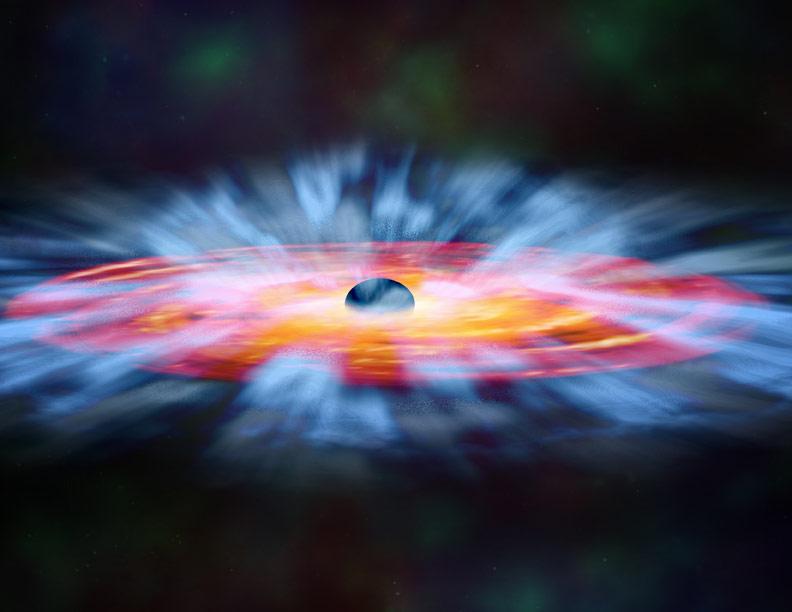
The withdrawal of the Divine is not altogether complete, and may be analogous to a type of spiritual “black hole” where the divine energy is kept in check. Some Kabbalists compare this progression to the residual fragrance that is left in a perfume bottle after its contents has been emptied. More importantly, there is a second aspect of the tsimtsum that is equally as important to the initial withdrawal of God—to Himself, so to speak: the reintroduction of the Divine light into the ontological void that reveals God as the Creator within the primordial space of this new emergent creation. As the celestial light of the Ein Sof (the Endless One) flows and contracts, and flows and contracts, it gradually brings order into the chaotic space until each dimension of Creation becomes increasingly more tangible and limited. Thus, new levels of phenomenal reality are created, finally producing this material universe with all of its diverse expressions.[7] There is a mystical verse in the Psalms that captures this imagery—the notion that God creates the universe by wrapping Himself in a garment of light (Psa. 104:2).[8] (See notes on Genesis 1:3).
In analogical terms, almost any kind of creative human activity requires a “clearing” of mental “space” so that the power of the imagination will reveal new creative thoughts and concepts. As the power of conceptualization unfolds, the nascent concept may seem like a thin beam of light entering into the conscious mind. Once this light appears, the intellect will expand upon the concept and eventually seek to manifest itself into an inspired product of creativity or a new idea—this process ought to be especially familiar to anyone who has ever attempted to write a book! Some Jewish mystics say that the process of tsimtsum can be recognized whenever a conscientious teacher clears his or her mind and distills a sophisticated thought so that even a young child may comprehend its new wisdom.
=============
Notes:
[1] Lawrence Fine, Physician of the Soul, Healer of the Cosmos: Isaac Luria and His Kabbalistic Fellowship (Stanford, CA: Stanford University Press, 2003), 144-149. Midrash Tanchuma, Vilnas Parshat Vyakhale 7.
[2] S. Buber, Midrash Tanchuma (Vilnas, 1885) Parshat Vyakhale 7.
[3] Rav J. B. Soloveitchik explains this rabbinic aphorism in terms of the tsimtsum doctrine. According to him, the entire Halachic enterprise is dedicated to realizing the Divine Presence into the lowly material world, “In the ideal world of Halacha, the concept of holiness means the descent of Divinity into our concrete world. This is how laws become the building blocks of the purely spiritual.” As a support for this theological premise, he quotes a biblical passage which reads: “For the Lord thy God walks in the midst of your camp” (Deut. 23:15) and the Rav further explains: “It is the contraction of the Infinity within a finitude of laws bound to laws, measures, and standards; the appearance of transcendence within empirical reality” cited from Zvi Kolitz’s Confrontation: The Existential Thought of Rabbi J.B. Soloveitchik (Hoboken, NJ: Ktav, 1993), 15.
[4] Gershom Scholem, Major Trends in Jewish Mysticism, Third edition (New York: Schocken, 1974), 260.
[5] Ibid., 261.
[6] Even “light” itself, is only a metaphor since spiritual light has no separate ontology apart from the Divine and is only meant to illustrate the primordial oneness that suffused all existence prior to the Creation of the universe.
[7] See Gershom Scholem, Major Trends in Jewish Mysticism. 3d ed. (New York: Schocken, 1961), 260-265.
[8] This idea is also alluded to in Me’or HaShemesh Parshat Bereshit:
והנה, אמרו חז”ל (ב”ר ג ד) על פסוק (תהלים קד ב) עֹטֶה אוֹר כַּשַּׂלְמָה, שנתעטף הקב”ה באור וברא את העולם. ורמזו בזה, כי השי”ת צמצם אורו שיהיה מקום לעמידת העולמות…

Respond to this post