Did King David Really Sin with Bathsheba?

After reading Neil N. Winkler’s new book, “Bringing the Prophets to Life: A Timely Look at a Timeless Story” (Jerusalem: Gefen, 2011), I felt elated. Somebody in the Orthodox world has finally written a book on the Prophets! The study of the Tanakh remains one of the most neglected areas of Jewish study in the yeshiva world today. The study of the Babylonian Talmud remains as popular as ever. The 12th century French Talmudist (and grandson of Rashi), Rabbanu Tam writes, “Nowadays, the study of the Babylonian Talmud has become the dominant focus of study. The early generations of scholars dedicated a third of their time studying the Scriptures.”[1]

Today, Artscroll, Judaica Press, Moznaim have translated a number of fine Orthodox works on the Tanakh, but tend these commentaries have a distinct medieval style that is unsuited for the 21st century. Winkler’s “Bringing the Prophets to Life: A Timely Look at a Timeless Story,” breaks away from these rather dull translations and expositions; he introduces a more conceptual approach to engaging and cross-examining the biblical texts most yeshiva students seldom ever study.

In the interest of brevity, I will focus on his treatment of King David and his affair with Bathsheba. For me, this particular biblical story deals with the humanity of David that is fascinating. The author discusses the Talmudic view, expressed by Rabbi Judah HaNasi, “Anyone who says King David ‘sinned,’ is simply mistaken” (BT Shabbat 56a). Admittedly, Winkler agrees that the Talmudic perspective is counterintuitive. After all, David does sleep with a married woman; he orders his general to leave Uriah, Bathsheba’s husband, exposed and unprotected in the midst of a raging battle. Talmudic interpretation argues that Uriah provided his wife with a religious divorce (a.k.a., a “get”) prior to his departure to the battlefield. Ergo, Bathsheba wasn’t really, “married,” but happened to be “halachically” divorced. (It’s a good thing King David didn’t have the Israeli Rabbinate advising him!!)

Winkler wonders: “With this clear declaration, our rabbis set forth a challenge to all traditional biblical scholars and students: How can we understand the story of David and Bat-Sheva as found and implied in the text in light of the Talmud’s declaration? Did David not sin at all despite ample references to his sin in the text? What were the rabbinical giants of the past conveying to the future generations?” (p. 108). After explaining the obvious and more straight forward meaning of the text, Winkler admits, “This is certainly not the David who is so God-sensitive and moral, the David who is so close to his men and his nation, the David we have gotten to know in the course of the twenty chapters . . .

Ok, we get it. David’s behavior doesn’t exactly strike one as “kosher.”

Winkler considers a number of possible expositions to the exegetical problem he poses. One approach suggests that the Talmudic statement is more of a “midrashic” homily, not to be taken literally. According to this reading, David’s behavior is simply, “beyond our ability to understand.” Maybe this is the kind of answer might satisfy the gullible yeshiva students, but it doesn’t satisfy people who live in the real world. Fortunately, Winkler rejects this tasteless approach. Besides, everybody knows King David had a passion for pretty ladies. David almost committed adultery wth Abagail, but fortunately for him-her husband died! David immediately proposes to Abagail, immediately after Nabal’s death! (cf. 1 Samuel 25:40-42.)

Surprisingly, Winkler argues that David did not actually commit adultery, for if he did—he would have been worthy of the death penalty. However, he is guilty of a “moral trespass.” By the standard of Gentile kings, David does nothing “wrong,” but God expects a higher standard from His anointed.

Sorry Rabbi, that statement doesn’t wash. Archaeological background might have helped Winkler on his last point. Adultery was not considered an acceptable form of behavior of any Semitic king in the ancient world! In Genesis 20:9, the Philistine King Abimelech refers to adultery as חֲטָאָה גְדֹלָה “the great sin.” When Joseph tried to persuade Madaam Potifar to stay away, he tells her that adultery is הָרָעָה הַגְּדֹלָה “great evil.” It is obvious that adultery is a sin-even by the standard of Gentile Kings!!

Ancient Israel’s disdain for adultery is consistent with the social attitudes found among Israel’s neighbors. For example: unearthed texts from Ugarit [2] and Egypt refer to adultery as a, “great crime.”[3] The ancients regarded adultery not as a crime against a life-partner, but as a sin against the gods. The protection of the integrity of the family unit was important because the family is the foundation of society. I will admit, Winkler’s comments probably describe the outrageous behavior of Roman emperors a lot better, but the Semitic kings of the ancient Near East had much higher ethical standards.

Winkler’s proofs are interesting—but certainly debatable! (1) The prophet Nathan never criticizes David for having committed adultery. Rather, he criticizes David for arranging Uriah’s death. (2) When David confesses his sin, he carefully says, “I have sinned to God,” i.e., he did not commit a sin against Bat Sheva. As further proof, Winkler cites the verse, “Against you, you alone, have I sinned, and done what is evil in your sight . . .” Finally, Winkler cites a third biblical passage where the biblical narrator briefly alludes to “the matter of Uriah the Hittite” (1 Kgs. 15:5) and never makes mention of this incident again.

Oy, Rabbi Winkler has studied way too much pilpul (hair-splitting Talmudic sophistry). Why must we defend every outlandish rabbinic statement? Since when are the Talmudic Sages infallible beings? Some of the rabbis thought Rebekah was 3 years old when she first met Isaac, or that the giant Og, hitched a ride on Noah’s ark. Some comments are just plain silly and are not oracles from Sinai.

Abarbanel’s commentary (ca. 15th century), offers a stinging criticism of King David—and represents a view that Winkler ignored.

  • Rabbi Judah HaNasi’s words are nothing more than a Midrashic homily, hardly requiring a response. I can easily excuse Rabbi Judah’s words, for he was a descendant from David [4], and was not really truthfully speaking . . . The Scriptures reveals all the sordid details of his illicit affair for all to see, and if David did not “sin,” how could he say, “I have sinned to the LORD”? Why did he go out of his way to repent in the most appropriate manner, as the verse attests, “Against you, you alone, have I sinned, and done what is evil in your sight . . .” (Psa. 51:5)? . . . I cannot and will not contradict the Scriptures on this matter! Rebbe’s opinion that “King David’s soldiers all issued a religious divorce to all of his soldiers, in the event they died in war” is simply not warranted by the text, for King David says to Uriah, “You have just come from a journey. Why did you not go down to your house? . . .(2 Sam. 11:10). . . . I would rather say King David truly sinned, and he truly repented and suffered greatly until he finally obtained atonement.

As a shepherd, David’s job was to take care of God’s flock—and not molest it. This is the entire point of the pastoral parable Nathan the Prophet gently conveyed to King David (2 Samuel 12:1-6). Nathan spoke respectfully to the King, and did not need to catalog each sin David committed in detail because he felt David had some redemptive potential.

Abarbanel’s commentary is important because he demands that we-the reader-be blatantly honest with the text. In addition to Abarbanel’s text, there is an interesting Mishnah that speaks about moral accountability. “If a person sends forth fire in the hands of a deaf-mute, an idiot or a minor he is not liable by the laws of man, but he is liable by the laws of Heaven.” [5] Ordinarily, if a person makes someone a proxy to do something wrong, the person who commits the crime is responsible (this obviously not so with an American court!). It is surprising the Talmudic teachers never thought to include David’s plot to kill Uriah as part of the Talmudic discussion. I suspect the rabbis did not wish to tarnish King David or his descendant, Rabbi Judah HaNasi. If anything, the story of Uriah proves that a man can still be guilty if he sent somebody to commit a heinous crime. Admittedly, my exposition does turn the rabbinic position on top of its head, but what else is a postmodernist (like myself) supposed to do?

In the final analysis, each person is answerable to God for one’s actions. This principle does not apply to someone who is irresponsible, but in the case of a King, the text makes it abundantly clear that the King is morally responsible if he delegates someone to commit mayhem in his name.

King David’s and King Ahab provide an interesting study in contrasts. Ahab covets “Naboth’s vineyard. The evil Jezebel uses a ruse to get Naboth killed for, “cursing the God and the King,” and poor Naboth is executed and his vineyard is confiscated (1 Ki 21:5-16). At first, Ahab’s behavior seems more forgivable, since he did not know about Jezebel’s conspiracy to get rid of Naboth. However, everything changes when he goes along with Naboth’s execution! Elijah condemns Ahab (and Jezebel’s) behavior and boldly says, “You shall say to him, “Thus says the Lord: Have you killed, and also taken possession?” You shall say to him, “Thus says the Lord: In the place where dogs licked up the blood of Naboth, dogs will also lick up your blood” (1 Ki 21:5-16). Naboth never shows any remorse for his behavior, much like Saul.

Winkler makes a fine distinction between King Saul, who denies all responsibility when the prophet confronts him, vis-à-vis King David, who soon acknowledges responsibility, once he is confronted by the evidence and truth—the mark of an honest leader. Throughout the Bible, God always uses weak people to achieve His purpose. David may be powerful on the battlefield, but his home life is a complete mess! I think many American families can easily relate to David’s foibles and humanity.

In contemporary terms, Bill Clinton’s affair with the young White House intern, Monica Lewinsky is a perfect illustration of a leader who denies moral culpability, especially when the whole nation confronts him with the evidence and truth. How can any modern Bible teacher not use such a fantastic illustration? The situation with Newt Gingrich’s infidelity is a bit more complicated, especially because he claims he has repented.

Who knows? Every saint has a past, and every sinner has a future.

Winkler’s book accomplishes his goal quite well. His book creates a dialogue. Intrabiblical texts offer a wonderful way to compare and cross examine well-known biblical narratives, which Winkler does a fine job weaving various passages together in making his points. I am sure the author hopes the conversation he has initiated shall move beyond the ideas he proposes in his book. No author can hope for anything more. In his next book, Rabbi Winkler may want to follow the style Nechama Leibowitz developed in her weekly parsha studies. All and all, Rabbi Winkler’s book held my interest. Continue Reading

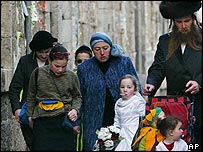
Today’s Pretenders of Talmudic Piety

The Neturei Karta cannot bear looking at the face of a woman—whether a real woman, or merely the image of a woman’s face, which they find “erotic.”

The philosopher Emmanuel Lévinas observed that the face is the only part of the body that we see in all of its nakedness. Lévinas develops this thought:

• Access to the face is straightaway ethical. . . . There is first the very uprightness of the face, its upright exposure, without defense. The skin of the face is that which stays most naked, most destitute. It is the most naked, though with a decent nudity. It is the most destitute also: there is an essential poverty in the face; the proof of this is that one tries to mask this poverty by putting on poses, by taking on a countenance. The face is exposed, menaced, as if inviting us to an act of violence. At the same time, the face is what forbids us to kill. (Ethics and Infinity 85-86).

The human face is God’s mirror; it is the reflection of our deepest humanity. It is capable of infinite expressions; emotions reveal the essence of our souls. How could we disrespect the one part of our neighbor’s humanity, whose countenance commands without words? The Ultra-Orthodox cannot look at a woman’s face, because to do so they would have to respect her humanity. Unfortunately, they do not see a human being with feelings, hopes and dreams. All they see is a sexual object to tantalize their forbidden thoughts and imagination. Nothing is more dehumanizing.

One prominent Orthodox rabbi, Rabbi Shlomo Aviner, decided to blot out the picture of Ruti Fogel, who was brutally murdered in the West Bank settlement of Itamar, along with her husband and children. Rabbi Aviner’s yeshiva, Machon Meir, publish some of the finest books in Judaic scholarship. It is a halachically progressive school. On the cover of the Machon Meir Newsletter, they blotted out her picture—allegedly, “out of respect.”

What kind of person gets sexually excited when seeing the image of a murder victim? Where is the “respect” in this kind of “halachic” ruling? The Machon Meir Yeshiva has actually dishonored someone who has died a Kiddush HaShem.

Somebody asked me the other day, “What is the Talmudic source for the Haredi ban on the woman’s face?” I thought about it. Actually, there is some antecedent in the Talmud. The Sages wondered, “What constitutes indecent exposure with respect to the She’ma prayer?” The Rabbis grappled with this issue:

R. Isaac said, “Anyone who gazes at one handbreadth of skin belonging to a married woman, constitutes sexual arousal.” Another rabbi said, “Even gazing at a woman’s pinky, constitutes indecent exposure. R. Hisda says, “Even a woman’s exposed leg constitutes indecent exposure.” Samuel said, “Even a woman’s voice constitutes indecent exposure!” (BT Berachoth 24a).

As strange as this Talmudic passage may seem to most of us, remember: the rabbis were concerned solely with a man’s intention, when uttering the She’ma. None of the rabbis prescribed burkas for the women of their community; nor did they tell their followers not to “look” at a woman.

Today’s Ultra-Orthodox acts more out of a sense of hubris; they believe that they are as pious as the rabbis were in the days of yore.

The Hasmonean King Alexander Jannaeus actually offers his Queen Salome some practical advice that one would not expect to hear, “King Jannai said to his wife’, ‘Fear not the Pharisees and the non-Pharisees. Beware of the hypocrites who ape the Pharisees; because their deeds are as immoral as Zimri’s; yet, they expect a reward like Phineas” (BT Shabbat 16b). Continue Reading

Abortion as an Ethical Dilemma 2/3

Although the Torah does not directly speak about willful destruction of the fetus as a “right,” nevertheless, the sanctity ancient Israel attributed to human life probably made abortion unimaginable.

The reason for this is simple: Infant mortality in biblical times was close to 50% and it is only natural that attitudes about voluntary abortion probably met with horror and disapproval. Arguments drawn from Scriptures seem inconclusive at best. The lone Pentateuchal source dealing with the legal status of the fetus comes from a section of Exodus dealing with the problem of miscarriage:

  • When men have a fight and hurt a pregnant woman, so that she suffers a miscarriage, but no further injury, the guilty one shall be fined as much as the woman’s husband demands of him, and he shall pay in the presence of the judges. But if injury ensues, you shall give life for life” (Exod. 21:22–23).

The verse may be interpreted in a two ways:

It would seem that the Mosaic legislation considered the fetus property, and should not be viewed as living person, like its mother. Financial compensation to the woman’s husband is determined by the judges, based on the development of the fetus. Such an interpretation has a parallel in the Hittite Laws, 17, in its treatment of the miscarriage. Most biblical translations regard verse 22 as referring to a miscarriage:

  • Some scholars[1] translate v. 22-23 differently, “If men fight and hit a pregnant woman and her child is born prematurely, but there is no serious injury, he will surely be punished in accordance with what the woman’s husband demands of him, and he will pay what the court decides” (NET). The term אָסוֹן (˒āsôn) does not mean “death,” as interpreted in the Mechilta, but ought to be rendered as, “health complications,” or, “serious harm,” to the child. Accordingly, if the v. 23 may be speaking of the death of the fetus as well, and the assailant is subject to the death penalty.

Based on the latter deconstructive reading, the death of a well-developed fetus could be viewed as a capital offense. Moreover even v. 22 may not necessarily be speaking about miscarriage as such, but a pre-mature birth and would involve lesser injuries to the mother and the baby—depending upon its physical development. Thus, according to this view, the fetus could be viewed as having a status similar or identical to that of human beings.

Other ancient codes of the ancient Near East (ANE) viewed voluntary abortion in grave terms. According to the Middle Assyrian Laws dating back to 1600 B.C.E., observes that if a woman died as a result of having induced her own abortion, her body was publicly impaled and denied a proper burial.[2] Assyrians viewed this act of impaling as a form of tallionic justice on account of the mother’s murdering of her fetus. According to the laws of Lipit-ištar, as well as the Middle Assyrian Laws, if the woman dies, the man himself will be put to death.[3] The Code of Hammurabi also includes laws regarding miscarriages and determines a monetary settlement based upon the mother’s social status.[4] The Hittite laws do not deal with the cases where the mother dies. Continue Reading

Abortion as an Ethical Dilemma 1/3

* This is an older article I wrote back in 2009. So, if there is any overlap of ideas, please forgive me.

Abortion, as such, is not discussed in the Tanakh. Explanations as to why it is not legislated or commented are at best speculative. The biblical world was much more concerned with the survival of its members, rather than with the willful termination of its unborn. Archaeological evidence suggests that in ancient Israel the infant mortality rate was about 50%.

Discussions concerning abortion are ancient indeed. The Torah imposes a fine on the assailant for causing abortion of a woman’s fetus in the course of a quarrel, and the penalty of death if the woman’s dies as a result of the assailant’s attack. “When two people who are fighting injure a pregnant woman so that there is a miscarriage, and yet no further harm follows, the one responsible shall be fined what the woman’s husband demands, paying as much as the judges determine. If any harm follows, then you shall give life for life, eye for eye, tooth for tooth, hand for hand, foot for foot, burn for burn, wound for wound, stripe for stripe” (Exod. 21:22-23).

Ancient Discussions

If the Code of Hammurabi is of any indication, the Torah had in mind only financial damages but did not advocate the death penalty for the death of the fetus—regardless how premature or maturely it was. In Section 209: Hammurabi writes, “If a man strike a free woman and cause her fruit to depart, he shall pay ten shekels of silver for her fruit.”

Perceptions regarding the status of the embryo changed centuries later during the days of Greek culture. A new interpretation was introduced that radically transformed our understanding of the biblical text. According to the ancient Greek translation of the Scriptures, the Septuagint, the Torah decreed that under certain circumstances, the death of the fetus could be imposed for causing an abortion:

ἐὰν δὲ ἐξεικονισμένον ἦν δώσει ψυχὴν ἀντὶ ψυχῆς

[And if two men strive and smite a woman with child; and her child be born imperfectly formed, he shall be forced to pay a penalty: as the woman's husband may lay upon him, he shall pay with a valuation.] But if it be perfectly formed, he shall give life for life . . . (Exod. 21:22)

Philo of Alexandria comments on this passage of the Septuagint, “But if anyone has a contest with a woman who is pregnant, and strike her a blow on her belly, and she miscarry, if the child which was conceived within her is still unfashioned and unformed, he shall be punished by a fine, both for the assault which he committed and also because he has prevented nature, who was fashioning and preparing that most excellent of all creatures, a human being, from bringing him into existence. But if the child which was conceived had assumed a distinct shape in all its parts, having received all its proper connective and distinctive qualities, he shall die; for such a creature as that is a man, whom he has slain while still in the workshop of nature, who had not thought it as yet a proper time to produce him to the light, but had kept him like a statue lying in a sculptor’s workshop, requiring nothing more than to be released and sent out into the world.[1]

Philo juxtaposes abortion with the ancient practice of exposure. He writes: “On account of this commandment he also adds another proposition of greater importance, in which the exposure of infants is forbidden, which has become a very ordinary piece of wickedness among other nations by reason of their natural inhumanity . . .”

Josephus also regards abortion as morally akin to murder.[2] Nevertheless, in practice, he followed rabbinical tradition, “He that kicks a woman with a child, so that the woman miscarry, let him pay a fine in money, as the judges shall determine, as having diminishing the multitude by the destruction of what was in her womb.”[3]

Josephus and Philo may have been of the opinion that the assailant had to pay two fines, one to the husband, and the second fine to charity for depriving the human race of one less person. It is also possible the Hellenistic understanding did run contrary to what later became Talmudic Halacha. Nevertheless, it does reflect the disdain Jews have had throughout history concerning abortion—at least as a method of birth-control. Given the high degree of infant-mortality, this reaction was quite understandable.

Unlike the Septuagint, Talmudic scholars maintained that the word אָסוֹן (´äsôn) “harm” refers to the woman and not to the fetus, since the scriptural injunction, “He who fatally strikes a man shall be put to death” (Exo. 21:12), did not apply to the killing of a fetus.[4] Ancient rabbis did not consider abortion a sin unless the fetus was viable בן קיימא (ben keyama)—still and all, if the infant was so much as only one day old , his killer is guilty of murder (Niddah. 5:3).[5]

According to the view of R. Ishmael, only a Gentile, to whom some of the basic transgressions applied with greater stringency, incurred the death penalty for causing the loss of the fetus (Sanhedrin 57b). Though abortion was frowned upon in the ancient world, it did not constitute murder.[6] In one well known Responsa of R. Yosef Trani (14th century), the author argued against a Jew assisting in an abortion, because it “places a stumbling block before the blind (Lev. 19:14).” This Halachic attitude did not apply to therapeutic abortion.

All this doesn’t necessarily mean that the rabbis had a permissive attitude concerning abortion. Clearly, it wasn’t. Thus we find in one medieval Midrashic work that Israel is praised because in spite of Pharaoh’s genocidal decree, in Egypt, “Every boy that is born you shall throw into the Nile, (Exod. 1:22), “Not one Israelite woman so much as harmed her foetus, much less after its birth. By virtue of their reverence for life, Israel merited the exodus” (Zohar II 3b).

Abortion is permitted if the fetus endangers the mother’s life. The Mishnah reads: “When a woman travails to give birth [and it is feared she may die], one may sever the fetus from her womb and extract it, member by member, for her life takes precedence over his”[7 This is the case only as long as the foetus has not emerged into the world, when it is not a life at all and “it may be killed and the mother saved.”[8] Once the birthing process has begun, if the greater part of the fetus has emerged into the world-either its head only, or its breach—it may not be touched, even if it endangers the mother’s life אין דוחין נפש מפני נפש (ein dohin nefesh mi-penei nefesh) “one may not discard one life to save another.”

In another passage of the Talmud, a newborn child is not considered to be viable, until it has lived for 30 days![9] How do we reconcile this passage with the above?

Back to the Future: Contemporary Perspectives

Rav Ben Tsion Uziel, the late Chief Sephardic Rabbi, observes in his Responsa, “When a child dies within 30 days, it is considered as if it was a stillborn and is not mourned for like a person who has died. It becomes evident only in retrospect, that it was stillborn [nofale] and that the period of its life was only a continuation of the mother’s vitality. Since there was no way to ascertain whether the foetus was indeed stillborn or not, it is not a crime one can be executed for because of doubt. Nevertheless, it is certainly prohibited to kill it because of doubt.”[10] This passage of Ben Uziel does have ramifications to another area of Halacha pertaining to discontinuing life-support mechanisms for a seriously impaired newborn baby. A more contemporary scholar, Rav Abraham Steinberg, notes “when in doubt, it is better to error in favor of life.”

Just to digress, it is interesting to note that in a similar way, Christian theologian Augustine raised a key question in his own time, as it is now, was “at what time the infant begins to live in the womb; whether life exists in a latent form before it manifests itself in the motions of the living being.” Augustine admits that he cannot assuredly say at exactly what point human life begins. He seriously questions whether any human has the power to decisively say. Nevertheless, he asserts that anyone who looked at the cut-up remains of an aborted baby would have to recognize that this had been a human life. Although Augustine apparently had a firm belief that a developing foetus participates in human life, he argues equally strongly here that a conclusive proof is outside our human ability. There is some leniency if for example, the abortion will save the mother from an illness deriving from an inflammation not connected with the pregnancy, or a poisonous fever . . . in these cases the fetus is not [per se] the cause of her illness.”[11]

Among modern Halachic authorities, psychological reasons are also a factor to allow abortions. The great 18th century Halachic giant, Rabbi Yaakov Emden, permitted abortion “as long as the foetus has not emerged from the womb, even if not in order to save the mother’s life, but only to save her from the harassment and great pain which the foetus causes her.[12]

One early 20th century scholar, Rav Ben Tsion Uziel, rules in favor of allowing an abortion in order to save the mother’s hearing, even though her life was not endangered. Disgrace and the quality of life are a very important factor to take into consideration when deciding whether one is undergo an abortion.[13] In the case of pregnancy resulting from incest, or any adulterous union, the 18th century savant, R. Yaakov Emden, permitted abortion so that the stigma of bastardy be attached to her offspring.[14]

With regard to the dreaded Tay-Sachs disease, Rav Eliezer Waldenberg permits the abortion, since as he writes in his Responsa: “One should permit abortion as soon as it becomes obvious from the results of the test that the child is indeed, a Tay-Sach’s baby will be born—even until the seventh month of pregnancy. If we are able to permit abortion according to the Halacha because of great need and because of pain and anguish, it seems reasonable that this is the classic case for extending such permission. And it is irrelevant in what way pain and suffering is expressed; whether it be physical or psychological—It is all the same. Indeed, psychological suffering in many ways in greater than the bodily suffering.”[15]

R. Eliezer Waldenberg also notes that whenever possible, all such abortions should be performed within the first forty days of the pregnancy or at least within the first three months.[16] Pope Gregory XIII [1572-85) expresses a similar view, and wrote that an embryo less than forty days was not yet considered human. Incidentally, it was only in 1869, Pope Pius IX who along with this doctrine of infallibility, decreed that the destruction of an embryo—even to save the mother’s life — was a mortal sin that merited excommunication from the Church.[17]

Many Orthodox scholars differ and are of the view that Jewish law prohibits abortion when its sole justification is to prevent the birth of a physically deformed or retarded baby. Likewise, abortion—on demand—purely for the convenience of the mother or even society is considered morally repugnant.”[18]

Suffice it to say as in any Halachic matter, there is no carte blanche answer for every conceivable case in Halacha—especially with regard to abortion. Every case must be determined by its own unique circumstances. A competent rabbi should be able to help guide any person who is wrestling with this important decision. There is no one answer for such a complex issue as abortion. Continue Reading

Early Rabbinic Reflections on Capital Punishment (Part 1/2)

There can be no doubt rabbinic tradition took a dim view of capital punishment. Mishnahic law required that those accused be warned by witnesses immediately before they commit the offense, and that they acknowledge such warning—a clear indication of the rabbinic distaste for capital punishment, explicitly found elsewhere.[1] Life imprisonment did exist for cases that could not technically be legally prosecuted, even though the evidence left no room for doubt[2]; such a person had to subsist on sparse diet of barley bread and water, and the Talmud indicates the criminal usually died from starvation. There may be a Scriptural allusion to this practice: the prisoner was condemned to eat “the bread of misfortune and the water of distress” (Isa. 30:20). Other rabbinic statements express even greater ambivalence:

  • R. Yose says, “Under no circumstances is one put to death unless both witnesses against him have given warning to him,” as it is said, ‘At the testimony of two witnesses’ (Deut. 7:6).”[3] He whose trial ended and who fled and was brought back before the same court—they do not reverse the judgment concerning him and retry him. He whose trial ended and who fled and was brought back before the same court—they do not reverse the judgment concerning him and retry him . . . A Sanhedrin which imposes the death penalty once in seven years is called murderous. R. Eleazar b. Azariah says, “Once in seventy years.” R. Tarfon and R. Akiba say, “If we were on a Sanhedrin, no one would ever be put to death.”[4] Rabban Simeon b. Gamaliel says, “So these Sages would multiply the number of murderers in Israel.”[5]

Moreover, the defendant may not be put to death unless two (or in some cases three) eyewitnesses testify against him or her. Each witness must be so certain of his testimony that he personally would be willing to carry out the execution. A passage from Deuteronomy 19:13-21 asserts that a plotting witness is subject to the same punishment as the defendant—including, presumably, death. Although the Torah prescribes the death penalty in the case of adolescent rebellion (i.e., “the rebellious son” of Deut. 21:18-21), the Sages admit, “Such a case never occurred, and it never will happen.” The entire passage is heuristic, so, “That you may study [the Torah for its own sake] and receive reward.”[6] The rabbinic angst and reticence to implement the death penalty, and its alternative system of imprisonment is of great relevance for modern biblical scholars and laity.

Rabbinic law is pretty straightforward about such cases. Maimonides writes, “The following rules apply when two groups of witnesses offer conflicting testimonies. If one witness from one group came together with one witness from the other group and they both delivered testimony concerning another matter, the testimony is of no consequence for it is obvious that one of them lied, but we cannot ascertain which one.”[7]Likewise Maimonides also notes, “Should a court err with regard to a case involving capital punishment and convict an innocent person, ruling that he is guilty, and they discover a rationale that would require that the ruling be nullified and he be vindicated, they nullify the ruling and retry the case. If the Court erroneously ruled and acquitted a person liable to be executed, then the judgment is not nullified and the case is not retried.”[8]

According to the Jerusalem Talmud, if one of a hundred witnesses is declared invalid, the entire testimony is rejected.[9]This was certainly the case here, and in a Jewish court, Troy Davis would never have been executed on this basis alone, and would have probably even been set free. Beyond this point, if the judge suspects the witnesses are indeed lying, he must refuse to render a decision upon the basis of their evidence (cf. Isa. 11:3-4).[10] Unlike American civil law that allows known criminals to testify in court against an alleged murderer, Rabbinic law prohibits the testimony of criminals either because they have zero credibility in rabbinical law and a valid witness is not even allowed to be associated with a dishonest witness.[11]

Continue Reading

Jerusalem’s “Eliot Ness”

The 1930s are one of the most famous periods of early 20th century American history. Most of us of the baby boomer era grew up watching the Untouchables.

Chicago, 1930, is best remembered for Al Capone, America’s most successful gangster, who made organized crime into a profitable business.

Capone’s nemesis didn’t have a cape or a utility belt; nor did he fly in the air, or leap over buildings in a single bound. No, Capone’s nemesis was a brave and honest lawman. This man could not be corrupted or intimidated.

His name was Eliot Ness, and he was a real American hero.

Ness took on the Capone mob. The mob could not intimidate him, despite having made murder threats to his family. Ness succeeded in doing the impossible: he arrested Capone and broke up his gang. His crime-fighting antics were very famous. Ness’s exploits inspired one of the most successful television shows of the 1950’s—the “Untouchables.” Kevin Costner directed a movie in 1987, based on the same storyline.

After Ness arrests Capone for tax evasion, he continued fighting organized crime, catching criminals with his bare hands; Ness broadened his crusade to include labor racketeers, crooked cops and the country’s most vicious serial killer, the Mad Butcher of Kingsbury Run. Pretty amazing for a man who didn’t even have a cape!

Israel may have its own version of Eliot Ness, and his name is Maj. Gen. Niso Shaham, who is Jerusalem’s District Police Chief. Every hero has his villain, and Shaham’s enemy happens to be the evil Neturei Karta and their henchmen, known as the Sikrikim (the “dagger men,” named after the infamous thugs who led a war against Rome, resulting in the destruction of the Temple and Jerusalem in 70 C.E.)

The Ultra-Orthodox Eda Haredit hate Shaham with a passion. They showed their contempt for Shahem by showing Hitler and Shaham standing side by side. Within a relatively short period of time, the Haredi responsible for the posters got arrested.

Since last May, Shaham has brought over 100 Haredim to justice—and he’s only beginning! Some of the people he arrested ran charity scams, and like Eliot Ness, Shaham is busting “their chops!”

Almost three years ago, the Sikrikim attacked a busload of Ultra-Orthodox special needs children, which was driving down Me’ah She’arim. As I have mentioned on other occasions, not all the Haredim are bad; many of them struggle like the rest of us, who are struggling to make a living. Although the Sikrikim did not physically harm the children, they did traumatize these children.

Haredi parents complained and begged the Jerusalem Police Department to do something to protect them. Seldom do the residents ever call the Israeli police (Most of them are anti-Zionist!), but this time was different. Enough was enough!

Shaham discovered that the head of the Edah Haredit court proved to be one of the kingpins of the Sikrikim group that has been terrorizing Haredi and Modern Orthodox Jews in Me’ah She’arim and Beth Shemesh.

Shaham arrested Rabbi Yitzhak Tuvia Weiss’s personal assistant: Amram Shapira, along with the heads of the National Committee. The message could hardly have been clearer: If the Sikrikim continue their intimidation and violence, Shaham is going to arrest the head Rabbi!

The other Haredi groups, most notably—the leaders of Gur Hassidic community—like, Deputy Health Minister Yaakov Litzman and others, enjoy seeing their picture with Shaham on the neighborhood posters. For the record, the Sikrikim threatened Litzman on numerous occasions. Litzman regards Shaham as a powerful ally. Continue Reading

A Portrait of Moses

After the wonderful exodus of the Israelites from Egypt, a king of Arabia sent an artist to Moses, to paint his portrait, that he might always have the likeness of the divine man before him. The painter returns with his handiwork before the King.

The King proudly displays the picture and asks his wise men to comment on the artistic work of Moses. What did the picture reveal? The artist depicts an evil looking man, disfigured by all the worse possible human attributes. The wise men said, “This looks like haughty, sensual, and evil man.” They added, “But the picture is still a masterpiece!”

“What a cheap consolation,” exclaimed the King, “How can I show it to Moses?” Feeling frustrated, the King of Arabia went to Moses and apologizes to him for showing such a disrespectful portrait.

Moses replies “Don’t be upset! Your artist and your experts alike are truly gifted masters. Their depiction is accurate. However, if my fine qualities were a product of nature, I would be no better than a log of wood, which remains forever as nature originally produced it.

He continued, “Let the truth be told, I must confess, I truly possessed all those reprehensible traits your wise men read in my picture and ascribed to me. They were more accurate than they could have possibly realized! However, over time I have learned to master my evil impulses, and I eventually learned to replace these evil habits with good habits so that I would finally become a new human being—Through these changes, and lots of hard work, I have become a respectable and commendable human being in the eyes of mortals as well as well as in heaven.”

This old medieval legend teaches us an important truth: Each of us has qualities we may not be proud of possessing. However, nobody is born a saint. Besides, every saint has a past, and every sinner has a future.

Redemption begins with facing our own inner darkness, which Carl G. Jung identifies as the “shadow.” Shadow defined by Jung, the archetype of the “shadow” represents the hidden or unconscious aspects of oneself—both good and bad—which the ego either represses or never recognizes, as he notes: “The shadow is the thing a person has no wish to be.”[1] The more unaware we are about this darker and amoral side, the less likely we will mindfully confront and change our inner nature.[2] To become self-aware, it is imperative that each of us find a way to integrate our “shadow” nature. This spiritual and psychological task is not without its challenges and difficulties, as Jung explains further:

“The shadow is a moral problem that challenges the whole ego-personality, for no one can become conscious of the shadow without considerable moral effort. To become conscious of it involves recognizing the darker aspects of the personality as present and real. This act is the real existential condition for any kind of self-knowledge, and therefore, as a rule, meets with considerable resistance.“[3]

Awareness of these internal psychological forces can enable a person to be deliberate in thought, word, and deed, while unawareness of the shadow can often lead to the scapegoating of others. Shadow projections are among some of the most pernicious attitudes evident in many social and racial biases. Misogyny, for example, is due to a man’s refusal to recognize his own inner feminine nature that yearns for a conscious expression. The same dynamic is present in any kind of social prejudice.

Conversely, it would be a mistake to identify the shadow with forces of evil; the shadow reflects the underdeveloped good that has yet to become fully realized and conscious. There is another element of the shadow that represents the repressed goodness each of us has which yearns to emerge into consciousness.[4] Jung refers to this presence of the psyche as the “Golden Shadow.” This manifestation of the psyche is always present in the heroes and heroines of the Genesis story. God refuses to give up on His chosen ones; Divine creativity turns inward, the human spirit is a work in progress. Jung explains further: “The shadow is not, however, only the dark underside of the personality. It also consists of instincts, abilities, and positive moral qualities that have either long been buried or have never been conscious. The shadow is merely somewhat inferior, primitive, unadapted, and awkward; not wholly bad. It even contains childish or primitive qualities which would in a way vitalize and embellish human existence, but—convention forbids!”[5]

Admitting that the shadow exists is a crucial step in breaking its compulsive hold on the individual. One of the best illustrations of this in the book of Genesis is the story of Jacob, a man who is in every sense a creature fashioned from the forces of Creation itself—light and darkness commingled as one. As a young man, Jacob feels spiritual yearnings within his heart, but acts ruthlessly in achieving his goals. Jacob’s transformation occurs once he becomes consciously aware of what he has been, and chooses to become something altogether different. By developing an awareness of his spiritual center, Jacob finally learns to shed the fears that commandeer his soul and discovers an inner center of peace. He discovers that blessings can only be obtained through just and honest means—without fanfare or manipulation. Continue Reading

The House of Cards

Haredi family

Religious societies probably grapple with the problem of shame more so than your typical secular community. Rigors of ordinary Orthodox Jewish life are daunting enough. When compared to the members of the Haredi community, Orthodox Jews might just as well consider themselves, “Reform,” or even Unitarian. The Haredi live as though they belong in the 18th century. The modern world with all of its technological wizardly threatens to unravel the foundations of their society. Bombarded by an endless stream of Internet images, they feel as though their world is collapsing—and it is.

Technology is only part of the problem. The world has changed; feminism has redefined the role of a woman in society. In premodern times, Jewish women usually spent their days cooking and cleaning the house. She was wholly devoted to raising her family. Today’s Haredi woman often finds herself forced to find work in order to support her family. She does it without fanfare. Today’s Haredi woman behaves like a classical “woman of valor,” mentioned in the book of Proverbs.

  • She is like the ships of the merchant, she brings her food from far away . . . She considers a field and buys it; with the fruit of her hands she plants a vineyard. She girds herself with strength, and makes her arms strong. She perceives that her merchandise is profitable. Her lamp does not go out at night (Proverbs 31:14-18).

What does the Haredi husband do? He sharpens his mind through the study of Talmud. He asserts his position as the man of the house, while everyone cringes in fear. Behind the bravado of the Haredi male is a person who suffers from low self-esteem. On some level, he feels ashamed he cannot provide for his family like other Haredim in the United States or in Europe. Most Haredi men lack the most basic skills to hold a job down; they are barely literate. Most of what they study in yeshiva is impractical. Their wives, on the other hand, interact with the modern world. These women have proven to be capable, personable, and successful. Haredi women are their family’s primary breadwinners and they are proud of their accomplishments! The men are jealous of their wives–and for good reason.

So what do these men do? They marginalize and bully the woman—not just their wives, but all women and girls. When they see a young and confidant Orthodox woman, they cringe with pain. They fear such women might actually inspire their wives to choose strength over weakness. They emphasize the “inferiority” of women by excluding them from aspects of public life, and segregating them in the back of the bus.

Why are the Haredi men doing this? The answer is simple: in their hierarchical society, they feel as though the walls of tradition are crashing down upon them from the force of modernity–and indeed they are!

Are the Haredi men completely responsible for this dilemma?

Not entirely.

Their rabbis enabled this kind of behavior for decades.

Prominent Hassidic (and Haredi) rabbis insist that none of their followers study in colleges for an education. As a result, their followers remained trapped in limbo between two opposite worlds: the pre-modern and the postmodern. Karl Marx warned us about the dangers of religious corruption when he said, “Religion is the opium of the masses.” The Haredi structure has a very strong Hassidic constituency,[1] but the Lithuanian and Sephardic components also support this mindset, howbeit to a lesser degree.

Hassidic rebbes, like Rabbi Israel of Ruzhin (1796-1850), developed a new trend that continues today. According to the Israeli scholar David Assaf, this Rebbe unabashedly demanded enormous sums of money from his Hasidim (presumably without offering kickbacks or illegally inflated tax-receipts). His garments consisted of outrageously lavish, silver and gold-laced outfits, favored royally and decorative walking-sticks. The Rebbe even had an orchestra to serenade him to sleep. He traveled in gilded chariot drawn by dozen white stallions (some say six Arabians, while others argue three Rumanian nags). And he infamously was fond of declaring, as a kind of personal motto, “All the money in the world belongs to me.”

You probably heard the old song, “Oy, diamonds are a Rebbe’s best friend!”

Rabbi Yisrael of Ruzhin was not the only one to behave this way. Many of today’s Rebbes have sometimes resorted to crime, money-laundering, and other terrible crimes in order to maintain their lavish lifestyle.

Although scholars like Martin Buber love to write stories about a Rebbe’s piety, not all of them were pious. In fact, many weren’t. Today’s successors in Jerusalem have no financial difficulty providing for their own families. Yet, they begrudge their followers to go out and get a college education. Contact with the outside world remains taboo. Their gullible followers live in squalor, and they take out their angst on their poor women, who are too fearful of the consequences if they fail to comply. An educated person knows how to think for oneself. Knowledge is power; it also creates an opportunity to succeed.

Christopher Hitchens once said, “Shepherds don’t look after sheep because they love them—although I do think some shepherds like their sheep too much. They look after their sheep so they can, first, fleece them and second, turn them into meat. That’s much more like the priesthood as I know it.”

Hitchens’ remarks especially apply to the Hassidic and Haredi rabbis, as well.

All the Halachic prohibitions and stringencies cannot prevent their world from imploding. What the Haredim really need are genuine leaders who deeply care for the flock God has entrusted them. They need leaders to encourage them to take responsibilities for their families; they need to encourage them to become givers, and not mere takers of society’s dole.

Uriel da Costa: A Jewish Tragedy for the Ages

California — Whenever I read the Lubavitcher website, it seems as if we are reliving history. The Lubavitcher lynching of Shmuley Boteach reminds me of how the 17th century Dutch Jewish community treated one of its heretical spirits and his name was Uriel da Costa (1585-1640).

Uriel was born in Portugal to a family of conversos (people who were forcibly converted to Catholicism) in the 16th century. After studying at Coimbra, he became interested in Judaism. His family fled Portugal and settled in Amsterdam, where he had hoped the Jewish community would welcome his return.

Or, so he hoped . . .

Uriel found the practices of rabbinic Judaism too rigid and mechanical as well as at odds with the ethical message of Tanakh. In 1624, he published one of his controversial books, Examination of the Traditions of the Pharisees Compared with the Written Law, which created shockwaves throughout the Amsterdam Jewish and Christian community.

Dutch officials burned Uriel’s controversial book, and he was fined for undermining the foundations of religious faith. Although the Dutch people were reasonably tolerant toward the Jews, the Jewish community feared Uriel might endanger their welfare, so the Jewish community decided to excommunicate Uriel da Costa. Using him as a scapegoat meant the Jews of Amsterdam could remain in safety.

Uriel was expendable.

Although Uriel felt strong about his religious principles, he finally decided to acquiesce to the Orthodox Jewish authorities of his time. If his readmission meant that he would, “become an ape, to live among apes,” he would do so, “Monkey see, monkey do.”

* Shades of Nancy Sinatra!

However, Uriel soon became disillusioned with Mosaic Law altogether, and felt that all religions were “human inventions.” By 1640, the Jewish community decided to discipline Uriel. They gave him 39 lashes in the synagogue. They placed a large door over him, and the Jewish community literally walked over him, treating him as though he was dead.

Little did the community realize that he would soon be.

After he returned home, he wrote his autobiography and committed suicide.

Uriel da Costa is a tragic story about how the Jewish community alienated one of its rebellious spirits. Young Benedict de Spinoza made sure that when he wrote his famous philosophical works, he instructed his followers to publish them posthumously.

Had there been a JTS or a Hebrew Union College in Amsterdam, both of these men would have found a home for their idiosyncratic ideas of theology. Unfortunately, they lived in a rather draconian period of Jewish history, a time when people preferred to burn books and ideas, rather than confront them with better ideas.

When I read about the Chabad reactions to Shmuley Boteach’s controversial, Kosher Jesus, I shudder to think what the Jews of Crown Heights would do if they were living in the 17th century. Although they cannot “walk over him,” as they literally did with Uriel da Costa, they are verbally dismembering him before the entire Jewish and Christian world to watch in disbelief. Continue Reading

Freud’s Great Intuition: Religion as Neurosis . . .

Not all Pharisees of the Talmud are worthy of our admiration. No, this statement is not one I personally originated; this idea actually comes from the Talmud itself.

Two thousand years ago, the Jewish community had an entire class of people who delighted in such feats of piety. The Talmud heaps scorn on the religious pretentiousness of these “foolish Pharisees.”

The Jerusalem Talmud writes, “Who is a man of piety that is a fool? “He, for example, who, if a woman is drowning, says, ‘It is unseemly for me to look at her, and therefore, I cannot rescue her. . . . Who is the pious fool? He who sees a child struggling in the water, and says, ‘When I have taken off my phylacteries, I will go and save him.’ By the time he arrives to rescue him, the child has already expired. Who is the crafty scoundrel? R. Huna says, ‘He is the man who behaves leniently toward himself, while teaching others only the strictest rules.’”[1]

“Our Rabbis have taught: There are seven types of Pharisees: the ostentatious Pharisee[2], the Pharisee who knocks his feet together and walks with exaggerated humility[3], the Pharisee is one who knocks his face against the wall rather than gaze at a woman[4] The Pharisee who feigns religious piety while constantly exclaiming, ‘What is my duty that I may perform it?’”[5]

You have just returned from Memory Lane.

Imagine a Haredi convention where the great rabbis come up with their latest technological and religious innovations designed to keep men and women apart. Wait until you see the latest fashions the Haredi rabbis decreed upon their enthusiastic followers. Mind you, I am not saying that all Haredi are lunatics-however, the Belzer, Satmar, Gerer Hassidim have hundreds of thousands of lunatics following some very shady religious leaders. I did not include the Lubavitch or the Bratzlav, for both of these movements operate on a principle of ahavat Yisrael-for the most part (but not always). This is obviously a topic nobody in the Haredi world want to talk about. Like most dysfunctional families, family “secrets” are necessary to allow the dysfunction to continue.

Now, back to our subject . . .

Last year’s innovations included:

  • A ban on mannequins.
  • The Personal Mechitza, which is a small partition Haredi Jews wear around their heads when travelling on El Al Airlines. The PM prevents Haredim from gazing at the lovely El Al Stewardesses. It comes in only one color: black.
  • Women must sit at the back of the bus!
  • How to attack Modern Orthodox girls walking to elementary school.
  • How to attack wheelchair bound children on Shabbat!
  • Rock concerts for Haredim during the Shabbat, where non-Haredim get stoned!
  • Separate sidewalks!

This year’s innovations include:

  • Use only “BLACK” rabbinically certified baby carriages!
  • Using gangs to intimidate other Haredi Jews.
  • Living like the Coneheads—special headgear for women designed to out-Taliban the Taliban burka!
  • Separate elevators for women as of 1/18/2012![6]

The Taliban are probably experiencing envy as you read this article. “Why can’t we become more religious, more fanatical like the Haredim?” asks a child to her mother.

Most of you have probably heard of OCD—Obsessive Compulsive Disorder. I personally prefer identifying this acronym as, “Orthodox Compulsive Disorder.” Hey, if the shoe fits, wear it!

OCD is a very common kind of anxiety disorder. Haredi behavior makes sense when you realize that all these new “halachic” acts of piety involves ways of coping with underlying anxiety, tension, anger, and guilt.

Most modern psychologists and therapists probably are not deeply in love with Freudian psychology, but I have a pretty healthy respect for Freud’s view of religion as an obsessional type of neurosis. Unlike Jung, Frankl, Rodgers, Fromm, and others who saw religions as serving a potentially positive function in society and in the life of the individual, Freud only concerned himself with the pathological aspects of religion that constricts rather than liberates the human spirit from its shackles.

When Freud wrote “Religion as Obsessional Neurosis” in 1907, he observed how religious people suffered from an overwhelming feeling of guilt:

  • We may say that the sufferer from compulsions and prohibitions behaves as if he were dominated by a sense of guilt, of which, however, he knows nothing so that we must call it an unconscious consciousness of guilt, in spite of the apparent contradiction in terms. This sense of guilt has its source in certain early mental events, but it is constantly being revived by renewed temptations which arise whenever there is a contemporary provocation. Moreover, it occasions a lurking sense of expectant anxiety, an expectation of misfortune, which is linked, through the idea of punishment, with the internal perception of the temptation. . . [7]

Freud was right. Religion for many people is a mental disorder. Continue Reading