A Portrait of Moses

After the wonderful exodus of the Israelites from Egypt, a king of Arabia sent an artist to Moses, to paint his portrait, that he might always have the likeness of the divine man before him. The painter returns with his handiwork before the King.

The King proudly displays the picture and asks his wise men to comment on the artistic work of Moses. What did the picture reveal? The artist depicts an evil looking man, disfigured by all the worse possible human attributes. The wise men said, “This looks like haughty, sensual, and evil man.” They added, “But the picture is still a masterpiece!”

“What a cheap consolation,” exclaimed the King, “How can I show it to Moses?” Feeling frustrated, the King of Arabia went to Moses and apologizes to him for showing such a disrespectful portrait.

Moses replies “Don’t be upset! Your artist and your experts alike are truly gifted masters. Their depiction is accurate. However, if my fine qualities were a product of nature, I would be no better than a log of wood, which remains forever as nature originally produced it.

He continued, “Let the truth be told, I must confess, I truly possessed all those reprehensible traits your wise men read in my picture and ascribed to me. They were more accurate than they could have possibly realized! However, over time I have learned to master my evil impulses, and I eventually learned to replace these evil habits with good habits so that I would finally become a new human being—Through these changes, and lots of hard work, I have become a respectable and commendable human being in the eyes of mortals as well as well as in heaven.”

This old medieval legend teaches us an important truth: Each of us has qualities we may not be proud of possessing. However, nobody is born a saint. Besides, every saint has a past, and every sinner has a future.

Redemption begins with facing our own inner darkness, which Carl G. Jung identifies as the “shadow.” Shadow defined by Jung, the archetype of the “shadow” represents the hidden or unconscious aspects of oneself—both good and bad—which the ego either represses or never recognizes, as he notes: “The shadow is the thing a person has no wish to be.”[1] The more unaware we are about this darker and amoral side, the less likely we will mindfully confront and change our inner nature.[2] To become self-aware, it is imperative that each of us find a way to integrate our “shadow” nature. This spiritual and psychological task is not without its challenges and difficulties, as Jung explains further:

“The shadow is a moral problem that challenges the whole ego-personality, for no one can become conscious of the shadow without considerable moral effort. To become conscious of it involves recognizing the darker aspects of the personality as present and real. This act is the real existential condition for any kind of self-knowledge, and therefore, as a rule, meets with considerable resistance.“[3]

Awareness of these internal psychological forces can enable a person to be deliberate in thought, word, and deed, while unawareness of the shadow can often lead to the scapegoating of others. Shadow projections are among some of the most pernicious attitudes evident in many social and racial biases. Misogyny, for example, is due to a man’s refusal to recognize his own inner feminine nature that yearns for a conscious expression. The same dynamic is present in any kind of social prejudice.

Conversely, it would be a mistake to identify the shadow with forces of evil; the shadow reflects the underdeveloped good that has yet to become fully realized and conscious. There is another element of the shadow that represents the repressed goodness each of us has which yearns to emerge into consciousness.[4] Jung refers to this presence of the psyche as the “Golden Shadow.” This manifestation of the psyche is always present in the heroes and heroines of the Genesis story. God refuses to give up on His chosen ones; Divine creativity turns inward, the human spirit is a work in progress. Jung explains further: “The shadow is not, however, only the dark underside of the personality. It also consists of instincts, abilities, and positive moral qualities that have either long been buried or have never been conscious. The shadow is merely somewhat inferior, primitive, unadapted, and awkward; not wholly bad. It even contains childish or primitive qualities which would in a way vitalize and embellish human existence, but—convention forbids!”[5]

Admitting that the shadow exists is a crucial step in breaking its compulsive hold on the individual. One of the best illustrations of this in the book of Genesis is the story of Jacob, a man who is in every sense a creature fashioned from the forces of Creation itself—light and darkness commingled as one. As a young man, Jacob feels spiritual yearnings within his heart, but acts ruthlessly in achieving his goals. Jacob’s transformation occurs once he becomes consciously aware of what he has been, and chooses to become something altogether different. By developing an awareness of his spiritual center, Jacob finally learns to shed the fears that commandeer his soul and discovers an inner center of peace. He discovers that blessings can only be obtained through just and honest means—without fanfare or manipulation. Continue Reading

The House of Cards

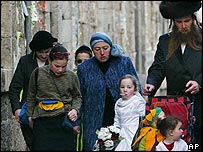
Haredi family

Religious societies probably grapple with the problem of shame more so than your typical secular community. Rigors of ordinary Orthodox Jewish life are daunting enough. When compared to the members of the Haredi community, Orthodox Jews might just as well consider themselves, “Reform,” or even Unitarian. The Haredi live as though they belong in the 18th century. The modern world with all of its technological wizardly threatens to unravel the foundations of their society. Bombarded by an endless stream of Internet images, they feel as though their world is collapsing—and it is.

Technology is only part of the problem. The world has changed; feminism has redefined the role of a woman in society. In premodern times, Jewish women usually spent their days cooking and cleaning the house. She was wholly devoted to raising her family. Today’s Haredi woman often finds herself forced to find work in order to support her family. She does it without fanfare. Today’s Haredi woman behaves like a classical “woman of valor,” mentioned in the book of Proverbs.

  • She is like the ships of the merchant, she brings her food from far away . . . She considers a field and buys it; with the fruit of her hands she plants a vineyard. She girds herself with strength, and makes her arms strong. She perceives that her merchandise is profitable. Her lamp does not go out at night (Proverbs 31:14-18).

What does the Haredi husband do? He sharpens his mind through the study of Talmud. He asserts his position as the man of the house, while everyone cringes in fear. Behind the bravado of the Haredi male is a person who suffers from low self-esteem. On some level, he feels ashamed he cannot provide for his family like other Haredim in the United States or in Europe. Most Haredi men lack the most basic skills to hold a job down; they are barely literate. Most of what they study in yeshiva is impractical. Their wives, on the other hand, interact with the modern world. These women have proven to be capable, personable, and successful. Haredi women are their family’s primary breadwinners and they are proud of their accomplishments! The men are jealous of their wives–and for good reason.

So what do these men do? They marginalize and bully the woman—not just their wives, but all women and girls. When they see a young and confidant Orthodox woman, they cringe with pain. They fear such women might actually inspire their wives to choose strength over weakness. They emphasize the “inferiority” of women by excluding them from aspects of public life, and segregating them in the back of the bus.

Why are the Haredi men doing this? The answer is simple: in their hierarchical society, they feel as though the walls of tradition are crashing down upon them from the force of modernity–and indeed they are!

Are the Haredi men completely responsible for this dilemma?

Not entirely.

Their rabbis enabled this kind of behavior for decades.

Prominent Hassidic (and Haredi) rabbis insist that none of their followers study in colleges for an education. As a result, their followers remained trapped in limbo between two opposite worlds: the pre-modern and the postmodern. Karl Marx warned us about the dangers of religious corruption when he said, “Religion is the opium of the masses.” The Haredi structure has a very strong Hassidic constituency,[1] but the Lithuanian and Sephardic components also support this mindset, howbeit to a lesser degree.

Hassidic rebbes, like Rabbi Israel of Ruzhin (1796-1850), developed a new trend that continues today. According to the Israeli scholar David Assaf, this Rebbe unabashedly demanded enormous sums of money from his Hasidim (presumably without offering kickbacks or illegally inflated tax-receipts). His garments consisted of outrageously lavish, silver and gold-laced outfits, favored royally and decorative walking-sticks. The Rebbe even had an orchestra to serenade him to sleep. He traveled in gilded chariot drawn by dozen white stallions (some say six Arabians, while others argue three Rumanian nags). And he infamously was fond of declaring, as a kind of personal motto, “All the money in the world belongs to me.”

You probably heard the old song, “Oy, diamonds are a Rebbe’s best friend!”

Rabbi Yisrael of Ruzhin was not the only one to behave this way. Many of today’s Rebbes have sometimes resorted to crime, money-laundering, and other terrible crimes in order to maintain their lavish lifestyle.

Although scholars like Martin Buber love to write stories about a Rebbe’s piety, not all of them were pious. In fact, many weren’t. Today’s successors in Jerusalem have no financial difficulty providing for their own families. Yet, they begrudge their followers to go out and get a college education. Contact with the outside world remains taboo. Their gullible followers live in squalor, and they take out their angst on their poor women, who are too fearful of the consequences if they fail to comply. An educated person knows how to think for oneself. Knowledge is power; it also creates an opportunity to succeed.

Christopher Hitchens once said, “Shepherds don’t look after sheep because they love them—although I do think some shepherds like their sheep too much. They look after their sheep so they can, first, fleece them and second, turn them into meat. That’s much more like the priesthood as I know it.”

Hitchens’ remarks especially apply to the Hassidic and Haredi rabbis, as well.

All the Halachic prohibitions and stringencies cannot prevent their world from imploding. What the Haredim really need are genuine leaders who deeply care for the flock God has entrusted them. They need leaders to encourage them to take responsibilities for their families; they need to encourage them to become givers, and not mere takers of society’s dole.