The House of Cards

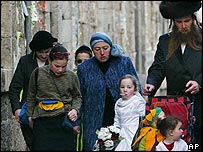
Haredi family

Religious societies probably grapple with the problem of shame more so than your typical secular community. Rigors of ordinary Orthodox Jewish life are daunting enough. When compared to the members of the Haredi community, Orthodox Jews might just as well consider themselves, “Reform,” or even Unitarian. The Haredi live as though they belong in the 18th century. The modern world with all of its technological wizardly threatens to unravel the foundations of their society. Bombarded by an endless stream of Internet images, they feel as though their world is collapsing—and it is.

Technology is only part of the problem. The world has changed; feminism has redefined the role of a woman in society. In premodern times, Jewish women usually spent their days cooking and cleaning the house. She was wholly devoted to raising her family. Today’s Haredi woman often finds herself forced to find work in order to support her family. She does it without fanfare. Today’s Haredi woman behaves like a classical “woman of valor,” mentioned in the book of Proverbs.

  • She is like the ships of the merchant, she brings her food from far away . . . She considers a field and buys it; with the fruit of her hands she plants a vineyard. She girds herself with strength, and makes her arms strong. She perceives that her merchandise is profitable. Her lamp does not go out at night (Proverbs 31:14-18).

What does the Haredi husband do? He sharpens his mind through the study of Talmud. He asserts his position as the man of the house, while everyone cringes in fear. Behind the bravado of the Haredi male is a person who suffers from low self-esteem. On some level, he feels ashamed he cannot provide for his family like other Haredim in the United States or in Europe. Most Haredi men lack the most basic skills to hold a job down; they are barely literate. Most of what they study in yeshiva is impractical. Their wives, on the other hand, interact with the modern world. These women have proven to be capable, personable, and successful. Haredi women are their family’s primary breadwinners and they are proud of their accomplishments! The men are jealous of their wives–and for good reason.

So what do these men do? They marginalize and bully the woman—not just their wives, but all women and girls. When they see a young and confidant Orthodox woman, they cringe with pain. They fear such women might actually inspire their wives to choose strength over weakness. They emphasize the “inferiority” of women by excluding them from aspects of public life, and segregating them in the back of the bus.

Why are the Haredi men doing this? The answer is simple: in their hierarchical society, they feel as though the walls of tradition are crashing down upon them from the force of modernity–and indeed they are!

Are the Haredi men completely responsible for this dilemma?

Not entirely.

Their rabbis enabled this kind of behavior for decades.

Prominent Hassidic (and Haredi) rabbis insist that none of their followers study in colleges for an education. As a result, their followers remained trapped in limbo between two opposite worlds: the pre-modern and the postmodern. Karl Marx warned us about the dangers of religious corruption when he said, “Religion is the opium of the masses.” The Haredi structure has a very strong Hassidic constituency,[1] but the Lithuanian and Sephardic components also support this mindset, howbeit to a lesser degree.

Hassidic rebbes, like Rabbi Israel of Ruzhin (1796-1850), developed a new trend that continues today. According to the Israeli scholar David Assaf, this Rebbe unabashedly demanded enormous sums of money from his Hasidim (presumably without offering kickbacks or illegally inflated tax-receipts). His garments consisted of outrageously lavish, silver and gold-laced outfits, favored royally and decorative walking-sticks. The Rebbe even had an orchestra to serenade him to sleep. He traveled in gilded chariot drawn by dozen white stallions (some say six Arabians, while others argue three Rumanian nags). And he infamously was fond of declaring, as a kind of personal motto, “All the money in the world belongs to me.”

You probably heard the old song, “Oy, diamonds are a Rebbe’s best friend!”

Rabbi Yisrael of Ruzhin was not the only one to behave this way. Many of today’s Rebbes have sometimes resorted to crime, money-laundering, and other terrible crimes in order to maintain their lavish lifestyle.

Although scholars like Martin Buber love to write stories about a Rebbe’s piety, not all of them were pious. In fact, many weren’t. Today’s successors in Jerusalem have no financial difficulty providing for their own families. Yet, they begrudge their followers to go out and get a college education. Contact with the outside world remains taboo. Their gullible followers live in squalor, and they take out their angst on their poor women, who are too fearful of the consequences if they fail to comply. An educated person knows how to think for oneself. Knowledge is power; it also creates an opportunity to succeed.

Christopher Hitchens once said, “Shepherds don’t look after sheep because they love them—although I do think some shepherds like their sheep too much. They look after their sheep so they can, first, fleece them and second, turn them into meat. That’s much more like the priesthood as I know it.”

Hitchens’ remarks especially apply to the Hassidic and Haredi rabbis, as well.

All the Halachic prohibitions and stringencies cannot prevent their world from imploding. What the Haredim really need are genuine leaders who deeply care for the flock God has entrusted them. They need leaders to encourage them to take responsibilities for their families; they need to encourage them to become givers, and not mere takers of society’s dole.

Uriel da Costa: A Jewish Tragedy for the Ages

California — Whenever I read the Lubavitcher website, it seems as if we are reliving history. The Lubavitcher lynching of Shmuley Boteach reminds me of how the 17th century Dutch Jewish community treated one of its heretical spirits and his name was Uriel da Costa (1585-1640).

Uriel was born in Portugal to a family of conversos (people who were forcibly converted to Catholicism) in the 16th century. After studying at Coimbra, he became interested in Judaism. His family fled Portugal and settled in Amsterdam, where he had hoped the Jewish community would welcome his return.

Or, so he hoped . . .

Uriel found the practices of rabbinic Judaism too rigid and mechanical as well as at odds with the ethical message of Tanakh. In 1624, he published one of his controversial books, Examination of the Traditions of the Pharisees Compared with the Written Law, which created shockwaves throughout the Amsterdam Jewish and Christian community.

Dutch officials burned Uriel’s controversial book, and he was fined for undermining the foundations of religious faith. Although the Dutch people were reasonably tolerant toward the Jews, the Jewish community feared Uriel might endanger their welfare, so the Jewish community decided to excommunicate Uriel da Costa. Using him as a scapegoat meant the Jews of Amsterdam could remain in safety.

Uriel was expendable.

Although Uriel felt strong about his religious principles, he finally decided to acquiesce to the Orthodox Jewish authorities of his time. If his readmission meant that he would, “become an ape, to live among apes,” he would do so, “Monkey see, monkey do.”

* Shades of Nancy Sinatra!

However, Uriel soon became disillusioned with Mosaic Law altogether, and felt that all religions were “human inventions.” By 1640, the Jewish community decided to discipline Uriel. They gave him 39 lashes in the synagogue. They placed a large door over him, and the Jewish community literally walked over him, treating him as though he was dead.

Little did the community realize that he would soon be.

After he returned home, he wrote his autobiography and committed suicide.

Uriel da Costa is a tragic story about how the Jewish community alienated one of its rebellious spirits. Young Benedict de Spinoza made sure that when he wrote his famous philosophical works, he instructed his followers to publish them posthumously.

Had there been a JTS or a Hebrew Union College in Amsterdam, both of these men would have found a home for their idiosyncratic ideas of theology. Unfortunately, they lived in a rather draconian period of Jewish history, a time when people preferred to burn books and ideas, rather than confront them with better ideas.

When I read about the Chabad reactions to Shmuley Boteach’s controversial, Kosher Jesus, I shudder to think what the Jews of Crown Heights would do if they were living in the 17th century. Although they cannot “walk over him,” as they literally did with Uriel da Costa, they are verbally dismembering him before the entire Jewish and Christian world to watch in disbelief. Continue Reading

Freud’s Great Intuition: Religion as Neurosis . . .

Not all Pharisees of the Talmud are worthy of our admiration. No, this statement is not one I personally originated; this idea actually comes from the Talmud itself.

Two thousand years ago, the Jewish community had an entire class of people who delighted in such feats of piety. The Talmud heaps scorn on the religious pretentiousness of these “foolish Pharisees.”

The Jerusalem Talmud writes, “Who is a man of piety that is a fool? “He, for example, who, if a woman is drowning, says, ‘It is unseemly for me to look at her, and therefore, I cannot rescue her. . . . Who is the pious fool? He who sees a child struggling in the water, and says, ‘When I have taken off my phylacteries, I will go and save him.’ By the time he arrives to rescue him, the child has already expired. Who is the crafty scoundrel? R. Huna says, ‘He is the man who behaves leniently toward himself, while teaching others only the strictest rules.’”[1]

“Our Rabbis have taught: There are seven types of Pharisees: the ostentatious Pharisee[2], the Pharisee who knocks his feet together and walks with exaggerated humility[3], the Pharisee is one who knocks his face against the wall rather than gaze at a woman[4] The Pharisee who feigns religious piety while constantly exclaiming, ‘What is my duty that I may perform it?’”[5]

You have just returned from Memory Lane.

Imagine a Haredi convention where the great rabbis come up with their latest technological and religious innovations designed to keep men and women apart. Wait until you see the latest fashions the Haredi rabbis decreed upon their enthusiastic followers. Mind you, I am not saying that all Haredi are lunatics-however, the Belzer, Satmar, Gerer Hassidim have hundreds of thousands of lunatics following some very shady religious leaders. I did not include the Lubavitch or the Bratzlav, for both of these movements operate on a principle of ahavat Yisrael-for the most part (but not always). This is obviously a topic nobody in the Haredi world want to talk about. Like most dysfunctional families, family “secrets” are necessary to allow the dysfunction to continue.

Now, back to our subject . . .

Last year’s innovations included:

  • A ban on mannequins.
  • The Personal Mechitza, which is a small partition Haredi Jews wear around their heads when travelling on El Al Airlines. The PM prevents Haredim from gazing at the lovely El Al Stewardesses. It comes in only one color: black.
  • Women must sit at the back of the bus!
  • How to attack Modern Orthodox girls walking to elementary school.
  • How to attack wheelchair bound children on Shabbat!
  • Rock concerts for Haredim during the Shabbat, where non-Haredim get stoned!
  • Separate sidewalks!

This year’s innovations include:

  • Use only “BLACK” rabbinically certified baby carriages!
  • Using gangs to intimidate other Haredi Jews.
  • Living like the Coneheads—special headgear for women designed to out-Taliban the Taliban burka!
  • Separate elevators for women as of 1/18/2012![6]

The Taliban are probably experiencing envy as you read this article. “Why can’t we become more religious, more fanatical like the Haredim?” asks a child to her mother.

Most of you have probably heard of OCD—Obsessive Compulsive Disorder. I personally prefer identifying this acronym as, “Orthodox Compulsive Disorder.” Hey, if the shoe fits, wear it!

OCD is a very common kind of anxiety disorder. Haredi behavior makes sense when you realize that all these new “halachic” acts of piety involves ways of coping with underlying anxiety, tension, anger, and guilt.

Most modern psychologists and therapists probably are not deeply in love with Freudian psychology, but I have a pretty healthy respect for Freud’s view of religion as an obsessional type of neurosis. Unlike Jung, Frankl, Rodgers, Fromm, and others who saw religions as serving a potentially positive function in society and in the life of the individual, Freud only concerned himself with the pathological aspects of religion that constricts rather than liberates the human spirit from its shackles.

When Freud wrote “Religion as Obsessional Neurosis” in 1907, he observed how religious people suffered from an overwhelming feeling of guilt:

  • We may say that the sufferer from compulsions and prohibitions behaves as if he were dominated by a sense of guilt, of which, however, he knows nothing so that we must call it an unconscious consciousness of guilt, in spite of the apparent contradiction in terms. This sense of guilt has its source in certain early mental events, but it is constantly being revived by renewed temptations which arise whenever there is a contemporary provocation. Moreover, it occasions a lurking sense of expectant anxiety, an expectation of misfortune, which is linked, through the idea of punishment, with the internal perception of the temptation. . . [7]

Freud was right. Religion for many people is a mental disorder. Continue Reading

Shmuley Boteach’s Battle with Lubavitch (9-17-12)

Whenever I read the Lubavitcher website, it seems as if we are reliving history. The Lubavitcher character assassination of Shmuley Boteach reminds me of how the 17th century Dutch Jewish community treated one of its heretical spirits and his name was Uriel da Costa (1585-1640).

Uriel was born in Portugal to a family of converses (people who were forcibly converted to Catholicism) in the 16th century. After studying at Coimbra, he became interested in Judaism. His family fled Portugal and settled in Amsterdam, where he had hoped the Jewish community would welcome his return.

Or, so he thought . . .

Uriel found the practices of rabbinic Judaism at odds with the ethical message of Tanakh, which he felt were too rigid and mechanical. In 1624, he published one of his controversial books, “Examination of the Traditions of the Pharisees Compared with the Written Law,” which created shockwaves throughout the Amsterdam Jewish and Christian community. The Dutch officials burned Uriel’s controversial book, and he was fined for undermining the foundations of religious faith. Although the Dutch people were reasonably tolerant toward the Jews, the Jewish community feared Uriel might endanger their welfare, so the Jewish community decided to excommunicate Uriel da Costa. Using him as a scapegoat meant the Jews of Amsterdam could remain in safety.

Uriel was expendable.

Although Uriel felt strong about his religious principles, he finally decided to acquiesce to the Orthodox Jewish authorities of his time. If his readmission meant that he would, “become an ape, to live among apes,” he would do so, “Monkey see, monkey do.”

However, Uriel soon became disillusioned with Mosaic Law altogether, and felt that all religions were “human inventions.” By 1640, the Jewish community decided to discipline Uriel. They gave him 39 lashes in the synagogue. They placed a large door over him, and the Jewish community literally walked over him, treating him as though he was dead.

But he soon would be.

After when he returned home, he wrote his autobiography and committed suicide.

Uriel da Costa is a tragic story about how the Jewish community alienated one of its rebellious spirits. Young Benedict de Spinoza made sure that when he wrote his famous works, he instructed his followers to publish them posthumously. Had there been a JTS or a Hebrew Union College in Amsterdam, both of these men would have found a home for their idiosyncratic ideas of theology. Unfortunately, they lived in a rather draconian period of Jewish history, a time when people preferred to burn books and ideas, rather than confront them with better ideas.

When I read about the Chabad reactions to Shmuley Boteach’s controversial, “Kosher Jesus,” I shudder to think what the Jews of Crown Heights would do if they were living in the 17th century. Although they cannot “walk over him,” as they literally did with Uriel da Costa, they are verbally dismembering him before the entire Jewish and Christian world to watch in disbelief.

Check out some of the comments any of you can find on:

http://collive.com/show_news.rtx?id=18125&alias=shmuley-boteach-blasts-collive [1]

Anyone peering from the outside might think Shmuley Boteach is a modern-day “heretic.” The term “heresy,” derives from the Greek αἵρεσις (heresis), which originally meant “choice.” In other words, heresy is another way of saying, “freedom of thought.” Religious communities typically chastise these rebellious spirits in their effort to censor ideas they find potentially “subversive” and “dangerous.” Continue Reading

The Symbolism of Forty

“I will send rain on the earth for forty days and forty nights.” —(Gen. 7:4)

Forty is a portentous number, for it represents the fullness of time. In general, it is usually a round number or estimation more so than an actual precise chronological measurement of time. As the medium of purification in the Torah, water has a unique power in that it can dissolve all the sundry forms it encompasses. In the realm of ritual, the waters of purification determine a new status, hence a new creation. Rabbinic literature develops this concept concerning the various laws pertaining to ritual purification and conversion.

In the Mishnah, for example, the waters of the mikvah (a “ritual bath”) must contain 40 se’ah (approximately 120 gallons) of water—the amount that is necessary to completely cover the human body as it undergoes ritual purification.[1] Ritual immersion represents a symbolic death for the person undergoing ritual. Upon arising, s/he becomes like a new person, as indicated by the Talmudic dictum, “Anyone who has become a proselyte is likened to a newborn baby.”[2]

Ritual immersion always introduces a change in status. For a priest, immersion enables him to eat from the priestly tithes; for the leper, immersion terminates his ceremonially impure status and facilitates his reintegrate to the community. In the same manner, the Flood lasted for 40 days and 40 nights and served as a means of purifying and purging the world of the violence that had infected it.[3]

Throughout the Tanakh and much of early rabbinic tradition, the number 40 is also associated with dramatic change, upheaval,[4] judgment [5] , hardship, affliction and censure, temptation and punishment, probation, [6] purification, forgiveness,[7] wisdom,[8] redemptive rescuing (as evidenced here) and finally, revelation.[9] The Jewish mystical tradition also sees a profound relationship among all these seemingly disparate nuances associated with the number.

On a psychological level, the number 40 seems to suggest that it is only when we are most broken and humbled we become spiritually open and receptive to God’s revelation and promise of renewal. From a Jungian perspective, 40 also corresponds to the period of life commonly known as midlife, when one often experiences turbulent changes as one comes to grips with mortality and the meaning of human existence. At midlife, that is when we start asking the great questions-even now as we wade our way through the current economic deluge our country is experiencing. Use this time to rediscover the real “You.” Continue Reading

Decision at the Twilight Hour

Scholars generally define the law of self-preservation as the instinct for individual preservation. The men who wrote the Geneva rules of war never anticipated a time when streets and malls would become battlefields. For thousands of year, warring nations generally realized that citizens are not soldiers. Soldiers must fight other soldiers. The reality of asymmetrical war has altered the way peoples across the world now fight. Fanatical religious regimes are making people rethink about the effectiveness of traditional deterrents (e.g., MAD). Today’s forces of Radical Islam revel in the apocalyptic destruction of a sworn enemy-regardless of the casualties and deaths they cause. Radical Islam poses exponentially greater problems today than the forces of Nazism presented to the pre-WII world.

Unlike Nazis, the forces of Radical Islam have no moral problem transforming their own children into human bombs. Try to remember that simple fact.

Had the European community taken a proactive position against Hitler’s Germany, the world might have been spared WWII; the death of over 25 million people might have been profoundly avoided.

Today’s efforts to prevent war include racial profiling, detention of those suspected of having terrorist connections, expansive surveillance through wire-tapping, computer hacking, cyber-warfare, assassinating known terrorists and their masters, pre-emptive attacks on known terrorist training camps, not to mention—outright pre-emptive war.

Without a re-visioning of these principles, Western civilization may not be able to withstand the force of an amoral enemy, who has no regard or respect for Western values—but holds these values we consider sacred as, “worthless.”

Does Israel have the moral right to unleash a pre-emptive attack on the Iranian nuclear reactors? The risks are obvious: Iranian population centers will suffer the brunt of nuclear fallout, but should Israel rather put the safety of its own people at risk and allow Iran or its affiliates to, “wipe Israel off the map”?

Israel has often used pre-emptive attacks in the past. When the Egyptian army crossed the Suez and blocked international waterways, Israel justly viewed these bold actions as a provocation for war. But again, Israel did bomb the Iraqi nuclear reactor in 1981, and the one Al Kabir nuclear reactor that Syria was trying to build in 2007.

Will the world condemn Israel once again? Of course, but what else would you expect? Will Obama chastise Israel? You can count on it! In 1981, the United States ambassador Jeane Kirkpatrick, described the attack as “shocking” and likening it to the Soviet invasion of Afghanistan.

Given the fact that Iran has supported Al Qaeda attacks on the United States military facilities and civilian targets, through their Hezbollah proxies, Israel would be wise to take Mahmoud Ahmadinejad at his word.

The spiritual leader of the Palestinian Authority, the Mufti Muhammad Hussein, went on record declaring, “The killing of Jews by Muslims is a religious, Islamic goal. The hour of Resurrection will not come until you fight the Jews. The Jew will hide behind stones or trees. Then the stones or trees will call out, ‘Oh Muslim, faithful servant of Allah-there is a Jew behind me, come and kill him!’” Continue Reading

The Crown Heights Witch Trials (1/15/12)

Kosher Jesus Boteach book cover“[My] book is telling the Jews to reclaim Jesus, the authentic Jesus, the historical Jesus, the Jewish Jesus” and to be inspired by his “beautiful” teachings, Rabbi Shmuley Boteach said this week in Jerusalem.

Shmuley Boteach reminds me a lot of Paul the Apostle. In fact, I think a comparison of these two individuals is interesting and intriguing. Paul would have definitely been a good Lubavitcher, if he were living today. Each of them shares a penchant for getting their names out there in the community. Each of them will do just about anything to get “noticed.” There are many other comparisons, but I will save that for another blog article in the future.

For now, I will share with my readers a brief review on Shmuley Boteach’s newest book, “Kosher Jesus” (Jerusalem: Gefen, 2012) I have read a number of reviews so far; some were surprisingly positive, while others are not-so-surprisingly critical.

As a writer, I think it is important to be kind to other writers; braving your soul and ideas to the public is not for the faint of heart.

With this thought in mind, I would like to begin with the positive aspects of his book. We must be living interesting times. When a member of the Lubavitch Hassidic sect writes a book about Jesus that is actually positive, we must marvel how much the world has changed since the time of the medieval period.

Shmuley has guts—I know, because I am an ex-Chabadnik. The Lubavitcher Rebbe hated Christianity and Jesus so much; he could never even mention Jesus’ name, without referring to him as “THAT man . . .” I understand the Rebbe’s animus; his family and community experienced the daily horrors of Russian anti-Semitism.

In the Haredi and Hassidic world, pious people save their worse curses for individuals who have historically brought great trouble to the Jewish people. Despite the thousands of talks the Rebbe gave in his life, Rabbi Schnersohn felt that Jesus was a non-person, someone whose name is best left unmentioned. “Even mentioning his name,” according to Rabbi Schnersohn, feeds the powers of impurity.”

Fortunately, we are living in more tolerant times.

Honestly, I admire Shmuley’s courage—as well as his marketing skills. I think Paul the Apostle would have been impressed. Unfortunately, nearly the entire Chabad community has chastised and eviscerated Shmuley’s reputation. I am astounded by the vast majority of Lubavitchers who have opinions on a book they have never read.

Given the large number of Jews for Jesus–100,000–Shmuley’s approach also strikes at the heart of Messianic Judaism’s Christology. Messianic Jews may rethink their relationship to Jesus after reading Shmuley’s book. Demythologizing Jesus is an important first step–otherwise, we risk losing a large number of Jews to Christianity. Shmuley mentions that according to the Talmud, there are at least two major Jesus figures. The Jesus of the Talmud was a student of Yehoshua ben Perachia (BT Sotah, 47a), who lived about 130 years before the destruction of the Temple. The temporal distortion alone reveals that Jesus of the NT could not have been his disciple. Other early rabbinic sources such as Seder Hadorot likewise explains there were two major Jesus figures-thus what we have here is what scholars refer to as an anachronism.

Personally, I think the title, “Kosher Jesus,” is a not an appropriate title for such a book. True, it may sell more books, but Shmuley has managed to alienate a large number of people in the process–especially those who can’t get past the book’s title. Showing a picture of Jesus’s stigmata is not what any Jew-secular or Orthodox-might expect. A more modest cover and title could easily have eliminated this problem. I am more surprised at the publisher-who happens to market Orthodox Jewish books!!

Shmuley embraces the evangelical Christian community—not in the spirit of polemics, but in the spirit of genuine friendship (on a personal note, we share that value in common). Many Jews across the religious spectrum dislike and distrust Christian evangelicals. Many fear the Christian evangelical’s support of Israel is solely based on their eschatological beliefs about the “Second Coming of Jesus.” While most of us are well aware of this reality, I am more concerned how the Evangelicals bravely stood with Israelis in Israel, when the Hezbollah missiles came flying into their towns.

Incidentally, some Chabadniks actually promote interfaith activities with the evangelical churches–and that’s something to think about.[1]

Most of the ideas found in the “Kosher Jesus” reflect the ideas of the British Jewish scholar Hayam Maccoby’s works. Like other NT scholars, before and after him, Maccoby argues Jesus was an observant Jew who followed Jewish law. Jesus erred in thinking that God would supernaturally bring about the end of the Roman Empire; he hoped God would let him inaugurate the Messianic Age that was foretold by the prophets. Jesus failed in achieving these goals, ergo—he could not be the Messiah.

There exists an elitism and Chabad-centricism that saturates today’s Chabad’s anti-intellectual culture. The Rebbes of Chabad are perceived as, “infallible,” much like the Popes of Catholicism. Chabadniks have no idea how much their sect resembles Pauline Christianity of Late Antiquity. It is a shame Chabad has retained Haredi Judaism’s disdain for secular education and history. When I was a rabbinical student in Kfar Chabad, all my books on biblical archaeology were confiscated and destroyed!

Chabad rabbis rarely (if ever) refer to the writings of Rabbi Ya’akob Emden (1697–1776). Rabbi Emden is widely considered one of the most important rabbinic scholars of the 18th century, greatly respected by the Vilna Gaon. In one of his small tracts, Rabbi Emden praises Jesus in his (Seder Olam Rabbah Vezuta):

  • It is therefore a habitual saying of mine (not as a hypocritical flatterer, God forbid, for I am of the faithful believers of Israel, and I know well that the remnant of Israel will not speak falsehood, nor will their mouths contain a deceitful tongue) that the Nazarene brought about a double kindness in the world. On the one hand, he strengthened the Torah of Moses majestically, as mentioned earlier, and not one of our Sages spoke out more emphatically concerning the immutability of the Torah. And on the other hand, he did much good for the Gentiles (provided they do not turn about his intent as they please, as some foolish ones have done because they did not fully understand the intent of the authors of the Gospels. I have recently seen someone publish a book, and he had no idea about what he was writing. For if he had understood the subject, he would have kept his silence and not wasted the paper and ink. There are also found among us foolish scholars who know not their right from their left in the Written and Oral Torahs and cause the people to err with their pompous pronouncements. But there are true scholars among the Christians, just as there are the chosen few among Torah scholars; and there are few of the truly great.) by doing away with idolatry and removing the images from their midst. He obligated them with the Seven Commandments so that they should not be as the beasts of the field. He also bestowed upon them ethical ways, and in this respect he was much more stringent with them than the Torah of Moses, as is well-known. This in itself was most proper, as it is the correct way to acquire ethical practices, as the philosopher (Maimonides) mentioned. We have written similarly in our Siddur. However, it is not necessary to impose upon Jews such extreme ethical practices, since they have been obligated to the yoke of Torah, which weakens the strength of the (evil) inclination without it. They have taken the oath at Sinai and are already trained in proper practice and nature. These are clear words that will not be rejected by a clear-thinking person.

More recently, Rabbi Shlomo Rivkin also praised Jesus in a video that created some firestorms within the Haredi community. Shortly after he made his video, Rabbi Rivkin sheepishly rescinded some of his remarks because he feared the Haredim of his community.

The video begins:

  • Shalom to all. My name is Shlomo Riskin. I am the Chief rabbi of the City of Efrat…..I am an Orthodox Rabbi…and an Orthodox Rabbi who is very profoundly interested in religion in general, in Christianity, and especially in the persona of Jesus in particular…. I was truly fascinated by the personality of Jesus, whom to myself I have always referred to as “Rabbi Jesus”….because I think he is indeed a “model Rabbi” in many counts…and he lived the life of a Jewish Rabbi in Israel in a very critical time in our history…..I have constantly come back to the study of his personality and his teachings which are very strongly rooted in Talmudic teachings…..”

Chabad cannot admit it: they do not have a monopoly on Jewish thought. In the words of the 20th century Russian writer Mikhail Bahktin, their thinking is totally “monological.” It is their way—or the highway. Rather than providing coherent reasons why Shmuley’s book is wrong, they would rather, “crucify” him instead, through nasty ad hominem attacks—which can be read at http://collive.com/show_news.rtx?id=18125&alias=shmuley-boteach-blasts-collive.

It is even more appalling to observe how the Crown Heights Chabad community is attempting to tar and feather Rabbi Chaim Miller, author of the Gutnick Chumash, for being Shmuley’s good friend.

The behavior of Hasidim in Crown Heights is a really shanda. They behave as if we are living in the Dark Ages. The Jewish world needs heretical spirits to wake it up from its stodginess and intellectual lethargy.

Kudos go to you Shmuley–for challenging antiquated attitudes that belong in the dustbin of history.

And so the Lubavitcher Witch hunt begins . . . I wonder how many bodies will they pile up?

Shmuley, take some good advice: Next time you write a book about Jesus, will you try to remember writing something about the Prodigal Son? (Sorry, Shmuley, I could not resist the humor in this statement.) Actually, the theme of this lovely parable has been often utilized by many Hassidic Rebbes, despite their ignorance of the original source.

Shmuley is a fine ambassador to the general community, but do not expect him to be something he is not—a New Testament biblical scholar. His book has value if you like something that is not too intellectually challenging. His criticisms of Pauline Christianity are very important and Chabadnicks would be wise to familiarize themselves with his arguments. If nothing else, it is nice to see one well (maybe I should really say, “ex”)-respected Lubavitcher break with the anti-Christian attitudes of the movement that spawned him.

However, if you want to read something much more historically intriguing and exciting, buy yourself a copy of the “The Jewish Annotated New Testament,” which is now available. This slim volume is a study edition of the NSRV translation of the New Testament with commentary and essays by Jewish Biblical scholars (including Jewish New Testament scholars) such as Marc Zvi Brettler, Amy-Jill Levine, Daniel Boyarin, and Mark Nanos. The scholars attempt to understand the NT from a respectful Jewish perspective. Such a work would hardly have been possible a few centuries ago. Fortunately, countless numbers of Christian scholars are now studying Talmud and other Judaic texts to better understand the life of Jesus as a Jew.

Another great book is Geza Vermes’ outstanding book, “Jesus the Jew: A Historian’s Reading of the Gospels” (Oxford, 1973). Vermes is a Holocaust survivor who converted to Catholicism, and later returned to Judaism. His perspective is scholarly, and very important for modern Jews who wish to really understand the unique message of Jesus during the days of the Second Temple. For a Christian perspective that examines Jesus in non-supernatural context, check out Marcus Borg’s outstanding, “Jesus: A New Vision” (NY: Harper Collins, 1991).

* Continue Reading

Expanding Upon Martin Luther King’s Dream for Ethiopian Jews in Israel

As we give pause to the memory of Martin Luther King and his profound ethical message concerning the evils of racial intolerance, it behooves us to ask ourselves: Have we, as a religious community, fully embraced the principles that cost this great man his life? Most American Jews have taken valuable steps in combating racism in our great country. However, some of us have yet to take a meaningful first step.

The Lubavitcher Rebbe spent many years preaching about the importance of ahavat Yisrael—on how, “we should love our fellow Jews.” However, the Rebbe and his Hasidic followers were careful never to admit that this great commandment does not apply to Ethiopian Jews. Since the famous rescue of the Ethiopian Jews (Beta Israel) in the 1980s, Chabad schools have adopted a policy that openly discriminates against Ethiopian Jews—despite the fact they have undergone Orthodox conversions in Israel and have been accepted in many Haredi yeshivas!!

Ethiopian parents often hear from Chabad principals, “We don’t take in Ethiopian children. We don’t think you match our lifestyle and we’re not sure about your Jewishness either.” This is exactly what five young girls of Ethiopian descent heard when they arrived with their parents at the “Or Chaya” school in Petah Tikva. By the way, Or Chaya is a Chabad school. Moshe Ashgara, the father of another girl, experienced the same treatment. “My daughter is a diligent student. Why won’t they take her?” That is a good question and the Principal of Or Chaya was unavailable for questioning.

The answer is simple: Chabad endorses racial discrimination against people it does not feel are “real Jews.” The late Lubavitcher Rebbe expressed doubts over the Jewish origins of Ethiopian immigrants to Israel and instructed that they be excluded from Chabad institutions—regardless whether they went through the most rigorous conversions.

Mind you, they have no problem accepting Jews from Ashkenazi and Sephardi backgrounds, not to mention, Jewish immigrants from the former Soviet Union. But not a single Ethiopian Jew is enrolled in the educational network. This policy applies not only to the Israeli secondary schools—it applies to every Chabad Heder and yeshiva all over the world.

Menachem Brod, spokesman for Chabad, confirms that Ethiopian children are not accepted in the Hasidic movement’s institutions. “This is an instruction from the Lubavitcher Rebbe and also a ruling by our rabbis,” he said. He also reiterated that the “Ethiopians are not being singled out, since Chabad policy applies to anyone whose Jewishness is in question.”[1]

When the Ethiopian Jews began their immigration from Ethiopia, the Chief Rabbinate obliged all immigrants to undergo giyur lehumra (pro forma conversion) because of doubts raised about their Jewishness by Ashkenazi ultra-Orthodox rabbis. However, in 1984 the rabbinate adopted as its official policy the well-known halakhic ruling that Rabbi Ovadia Yosef - the spiritual leader of Shas - issued a decade earlier, which held that there was no doubt about the Jewishness of the Falasha, the Beta Israel (Ethiopian Jews ). From this point on, instead of the demand to undergo conversion, members of Beta Israel wishing to marry had to undergo a “clarification of Jewishness.”

Rabbi Moshe Feinstein wrote to his son-in-law, Rabbi Moshe Tendler concerning the Ethiopian Jews:

  • As you mentioned, they should not be brought to the Land of Israel, unless they have undergone a conversion, in order to not increase the concern for assimilation [i.e., intermarriage with Jews who do not have a doubt regarding their Jewish status and also a weakening of the faith of Ethiopian Jews themselves]. But if they have legally converted, and as I have heard they are doing, we shall consider them like all Jews, and one must assist them and support them for all needs of livelihood, both physically and spiritually. And I suffered great anguish because I have heard there are those in Israel who are not drawing them close in spiritual matters and are causing, G-d forbid, that they might be lost from Judaism. And it seems to me these people are behaving so only because the color of the Falashas’ skin is black. It is obvious that one must draw them close, not only because they are no worse than the rest of the Jews – and because there is no distinction in practical application of the law because they are black – but also because one can say perhaps they are gerim [converts], and are therefore included in the mitzva “and you shall love the convert.”[2]

For the record, the Lubavitcher Rebbe never endorsed the rescue of Ethiopian Jews in their most critical time of their history. Every other major Halachic scholar accepted the Ethiopian Jews as Jews, but many did insist upon a pro-forma conversion in the event of marriage.[3] This is all the more amazing when one considers that the Lubavitcher Rebbe always stressed the importance of saving lives superseded even the laws of the Shabbat!

Last week, Channel 2 in Jerusalem exposed an agreement signed by residents of an apartment complex in Kiryat Malachi that forbade the sale or rental of apartments to Ethiopian Jews – even if the potential renter was an exemplary Israeli citizen, and their decision was extensively backed by a Chabad neighbor who wrote an essay defending the racism. Such behavior embarrasses Jews everywhere, and our enemies use these stories to tarnish Israel’s reputation to the world.

If the Haredim in Israel are willing to accept the Ethiopian Jews, one must wonder: Why won’t the Chabad also accept the Beta Israel? Why should the Chabad institutions receive a free pass to continue their racial discrimination? In fairness to the Chabad public, it is doubtful whether most of their supporters are even aware of this problem. However, the organization leaders may want to rethink the Rebbe’s position because it goes against the vast majority of Haredi rabbis, who have for the most part, openly embraced the Ethiopians in Israel. Clearly, Rabbi Schnersohn has been overruled by the vast majority of Torah scholars of his time, and it is foolish to continue a policy that is so morally offensive, not to mention—contrary to Halacha.

About 2,000 people gathered on Tuesday to demonstrate against racism in Kiryat Malakhi, after members of the Ethiopian immigrant community there said that local homeowners’ committees refuse to rent them apartments. They were joined by hundreds of people who came from around the country to support them.

What a shanda!

A pig with lipstick is still a pig, and racism-even-with a smiley face is still racism.

The Israeli government is outraged about this shabby treatment of Israel’s beloved Ethiopian Jewish community and promises to strike hard at the racist policies that are harming the Jewish people of Israel. President Shimon Peres expressed our sentiments with eloquence, “The racists should be ashamed of their actions and their words,” Peres said on Thursday. “When we established the state, our dream was that Ethiopian Jews would immigrate to Israel, along with Libyan Jews, Russian Jews and Jews from all over the world.”


Notes:

[1] “Chabad School Refuses to Accept Ethiopian Students,” Chabad News on September 08 2011, http://www.crownheights.info/index.php?itemid=37556.

[2] Cited in Igrot Moshe Vol. 9 (I have personally ordered the book, and I promise to cite the response when I receive it in the mail.

[3] R. Eliezer Yehudah Waldenberg, Ziz [i.e, Tzitz] Eli’ezer, 10:25,ch. 3, sec. 10; Tzitz Eli’ezer, X, no,. 25, chap. 3, sec. 19.

Dancing with Wolves: Shmuely Boteach and His Lubavitcher Critics

I could not help but read the Chabad reaction to Shmuley Boteach’s new book, Kosher Jesus. Most of us, who have no inner access to the Chabad inner circle, might be surprised by the ferocity of the Lubavitchers’ reactions.

Rabbi Yitzchok Wolf, Dean of SJ Abrams Cheder Lubavitch Hebrew Day School in Chicago, wrote a scathing attack on Boteach’s book, even though he did not bother reading it. Wolf writes, “With utter contempt I have read the title of Shmuely Boteach’s new book ‘Kosher [Yoshke].’” Note that “Yoshke” is the contemptuous name Hasidic Jews give to Jesus.

Wolf goes on to say, “This book is telling the Jews to reclaim J…, the authentic J…, the historical J…, the Jewish J….” and to be inspired by his “beautiful” teachings, as this author and TV show host told Ha’aretz this week in Jerusalem. This book poses great danger to thousands of unsuspecting Jews who are approached daily by Jews for J with the sole purpose of getting them to embrace Christianity. To Jews for J this book will now become the Jewish Rabbinical textbook urging embracing Yoshke as an authentic Jew, urging us to be inspired by him, G-d forbid.”

My old Professor Lewis Rambo (no relation to Sylvester Stallone) once explained how closed societies build a force field around their communities; contact with undesirable people or thinkers are in a manner of speaking, quarantined. Since Boteach’s days at the Chabad House of Oxford, G.B., Chabad has always viewed Boteach with suspicion. After all, what kind of Chabadnik writes articles for Playboy Magazine, or associates with people like Michael Jackson?

The other reactions from the Lubavitcher community are laced with criticism. “Thank you for saying what nobody seems to have the courage to say…” Another person writes, “Thank you Rabbi Wolf, it is refreshing to see a Shliach [Lubavitcher emissary] who is not afraid of what others will think, and not afraid to say the truth… The silence is deafening . . . we should be hearing an outcry”

Reacting to Wolf’s condemnation of Kosher Jesus, one man writes, “This is quite possibly the most judgmental, disparaging, close minded statement EVER made on this site. It’s obscene and unheard of to not only “judge’ but condemn a book by its cover.”

Then again, the critic cites Wolf, “There is absolutely no need to read the actual content of the book; the title will do more harm than imaginable, Heaven forbid!!

The condemnations get even more interesting:

  • I just read the Ha’aretz article and comments—what Boteach has done is a complete Chillul HaShem. He has no Rav, no Mashpia and clearly suffers from delusions of grandeur and messianic complex. I used to like Shmuely until I was in Israel and turned on the television in my hotel room to discover him on his show with a women who had been recently widowed and he COULDN’T STOP HUGGING HER. He decided that shomer nagiah no longer applies to him. To me, that was the beginning of the end. We cannot trust anything he says or does. Will the frum world put him in Cherem? We must take action to stop this ego maniacal monster. He is rewriting our holy Torah.

Another reader argues that public condemnations of Boteach’s book are actually helping Boteach sell more books! He writes:

  • Rabbi Wolf, how much did Shmuely pay you to make this most horrendous statement? Nothing sells books like controversy. You noticed the title (don’t judge a book by its cover) and what was written second hand. Had you a least gone to Amazon and read the table of contents, you would have seen a major section of the book is “WHY JEWS CAN’T BELIEVE IN J.”Seems you have been duped.

One person makes an observation that I completely endorse.

  • Rabbi Boteach’s book shows that Yushke wanted people to keep Halacha completely and shows that Yushke did not think he was a god, and that the Christians rewrote his life story and lied about him. There are 100,000 Jews who have converted to Christianity in America and no one is successfully doing anything to reach out to them and bring them back to torah. This book could help them return to Yiddishkeit. This book {shows}Christianity is a lie and is a very good tool in anti missionary work.

This particular respondent hits the nail on its head. Boteach has taken a bold step in trying to reach out to the Messianic Jewish community, in an effort to raise some cognitive dissonance among its ranks.

Personally, I have engaged a number of “Jews for Jesus” in discussion with the sole purpose of showing them how and why the Jesus of Christianity is the creation of Paul and the Early Church Fathers. Historically, Jesus’s brother James, felt nothing but contempt for Paul. In his view, Paul transformed Jesus into something that was totally alien to Jesus’s overall message. Once I have demonstrated James’ negative opinion of Paul the Apostle, a fair number of the Jews for Jesus have abandoned their cult, and I have helped many of them return to Judaism. In the controversial 1988 film, The Last Temptation of Jesus Christ, producer Martin Scorsese (a Catholic), took quite a bit of heat from the Christian world when he portrayed Jesus as a sensuous man, who marries Mary Magdalene, raises a huge family and lives a full life.

True to my contrarian nature, I argued that the real heresy is when Jesus in a vision (produced by Satan himself), hears Paul the Apostle preaching about the miracle of Jesus’ resurrection; Jesus discovers that his mother was a virgin, while he is “son of God.” Jesus confronts Paul, and asks him, “Did you ever see this ‘Jesus of Nazareth?’ Paul sheepishly admits, all he saw was the blinding white light on his way to Damascus.

Jesus then reveals his identity to Paul. Bluntly, Jesus asks, “Why are you promoting this nonsense about me ‘rising from the dead’ ? . . . I live a normal and happy life for the first time . . .” and he threatened to expose Paul for the fraud he was. Paul basically admits that he made up the story because people need someone to believe in and that he was willing to make up just about anything so that people would believe in something that would give purpose to their lives. Striking is Paul’s comment, “I will crucify you and resurrect you if I have to. . . The Jesus Christ I believe in is greater than you . . .”

It is a pity Shmuely does not refer to the Last Temptation. It’s a greater pity Shmuely didn’t write an entire chapter about James, Jesus’s brother. Unlike Paul, who believes a man is saved by faith alone, James differs; he is concerned about the primacy of deeds; behavior reflects one’s true values and faith more so than all the platitudes about faith. No man can be “saved” by faith alone—as Paul taught, but each man can gain Eternity through living an ethical life that includes integrity and compassion. When reading the book of James, we can better understand Jesus’s real message. It is a pity the Early Church did not name itself, “Paulanity,” instead of “Christianity.” Paul alienated the Jewish community from Jesus more than anyone else. Boteach seems to share this position as well. It is a pity that Lubavitchers are not looking at the total picture here.

Lubavitchers do not want to know anything about Jesus. For them, Jesus is the reason why so many Jews have died throughout for almost 2000 years. The Rebbe and his followers would rather hold on to a medieval mindset and ignore the facts that contradict rabbinic opinions found in the Talmud and Maimonides.

Modern NT scholars have shown that the historical Jesus is not the same as the Jesus of Paul and the Early Church. The Jesus Seminar scholars have done a fabulous job showing the evolution of the NT and how the New Testament assumed its present form.

If Jesus were to appear today, he would scarcely recognize the religion that has arisen in his name. In all likelihood, he would attend a synagogue for Shabbat services and conduct himself like a religious Jew—and not a Christian. Continue Reading

Defining “The Great Commandment” — An Ancient Debate

It’s a pity many Hasidic Jews do not study or take to heart the Ba’al Shem Tov’s ethical message about loving one’s neighbor as oneself. It’s also a pity when outstanding Lithuanian scholars don’t live by the ethical imperatives found in the Talmud and Midrashic literature.

The ancient Sages of Israel often debated about the ethical hierarchy of precepts. Such debates existed even in the first century. In the NT, a Pharisee asks Jesus:

  • “Teacher, which commandment in the law is the greatest?” He said to him, “‘You shall love the Lord your God with all your heart, and with all your soul, and with all your mind.’ This is the greatest and first commandment. And a second is like it: ‘You shall love your neighbor as yourself.’ On these two commandments hang all the law and the prophets.”[1]

In the Halachic midrashim of the second century, the early Sages also occupied themselves with similar questions. They asked: What is the most fundamental ethical principle of the Torah? Rabbi Akiba derives his ethos from the verse, “Love your neighbor as yourself” (Lev. 19:18). Ben Azzai differs: “Do not say, ‘Since I have already been put to shame, it does not matter to me, whether somebody shamed my neighbor!’ “Not so,” says Ben Azai, “Shaming is wrong, for God has made every person in his likeness.”

Put in more contemporary terms: Self-respect begins with realizing the unique image of God that each human being possesses. Recognizing this ethical reality holds the key to recognizing this quality in others. Even when someone shames you, such disparaging treatment does not entitle you to reciprocate in kind—even in the face of provocation. All forms of human degradation harm the divine image, while denying the essential brotherhood and sisterhood of humankind. Affirming the Divine image is by far the most comprehensive principle of the entire Torah—it is the essence of all biblical morality.[2]

For R. Akiba, love is the highest value for interpersonal relationships. However, for Ben Azzai, human society depends upon respecting the divine image in oneself and others. Without this principle, how will the human community survive? Elsewhere, Ben Azzai extols the uniqueness of the human individual, “Do not despise any human being and do not consider anything as improbable—for there is not a man who does not have his hour, and there is not a thing which does not have its place.”[3] There is no human being in this world that does not have the capacity for excellence and spiritual growth.

Going one step further, there is a rabbinic poignant story which deepens this point of Ben Azzai:

  • Rabbi Shimon ben Elazar had returned from a trip in Migdal Eder, from his teacher’s house. As he was riding on his horse, he met a certain man who was exceedingly ugly. Rabbi Shimon said to him, “Raka (simpleton), how ugly are the children of Abraham our father.” The other man replied, “There is nothing I can do about this! Why do you not complain to the Craftsman who made me?” Rabbi Shimon immediately alighted from his horse and bowed before the man saying, “I apologize to you, please forgive me.” He replies to him, “I will not forgive you until you go to the Craftsman Who made me and say, “How ugly is the vessel which You have made.” Rabbi Shimon walks behind him for three miles. When the townspeople heard of Rabbi Shimon’s arrival, they came out and met him; they greeted him with the words, “Peace be unto you, rabbi.” The other man says to them, “Who are you calling rabbi?” They reply, “The man who is walking behind you.” He then exclaims, “If this man is a ‘rabbi,’ I sure hope he is the last of his kind in Israel!” He told the people the whole story, and the townspeople begged him to forgive the rabbi, and he agrees, only on one condition—he must never act in this manner toward anyone again.[4]

As is the case with so many of the rabbinic anecdotes dealing with ethics and human nature, this story is a good example of how the Jewish community understood the image of God in practical and ethical terms. According to R. Abraham Isaac Kook, the love of humankind and God are insuperably related. One cannot love God and hate His creation. According to Kook, the love of humankind must transcend the narrow confines of tribal loyalty; it is all-inclusive of every religious and ethnic grouping. In Kook’s description, one sees the complete synthesis of Ben Azzai and R. Akiba:

  • Love for humankind must be alive in one’s heart and soul—love for each individual separately, and love for all nations, [together with] desire for their advancement and for their spiritual and material progress—… an inner love from the depths of one’s heart and soul, to be beneficent to all nations, to add to their material wealth, and to increase their happiness.…The highest form of love for all creatures is love for human beings, and it must include all people . . .For only when one is infused with love for God’s creatures and all humankind can one elevate love of country to its most noble level, both spiritually and materially. Narrow-mindedness, which results in seeing everything outside the boundaries of one’s own country—even if that country is Israel—as repulsive and unclean, is extremely contemptible; it leads to wide destruction of every valuable spiritual resource to which every decent person looks for enlightenment. [5]


Notes:

[1] NT. Matthew 22:36-40.

[2] Sifra, Kedoshim 4:12. In Genesis Rabba 24:7, the order is reversed, but there can be little doubt that the Sifra represents the older of the two traditions.

[3] Mishnah Aboth 4:3.

[4] Tractate Derech Eretz (Chapter 4).

[5] Cited from M. Elon, Jewish Law: History, Sources,Principles = Ha-mishpat ha-Ivri (Philadelphia: Jewish Publication Society, 1994), Vol. 3, 1852.