
Truth is liberating.
Present generations of rabbinical scholars have a responsibility to address and correct the sins of the past.
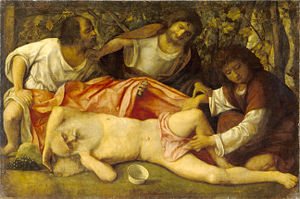
Glossing over the texts that have historically endorsed racism serves no positive purpose. Silence is complicity and nobody deserves a free pass. Here is a sampling of some of the rabbinical texts in question. For example, “Noah said to Ham, “You have prevented me from doing something in the dark (i.e. cohabitation), therefore your seed will be ugly and dark-skinned.†[1] According to another source, “R. Hiyya said, ‘Ham and the dog copulated in the Ark, therefore Ham came forth black-skinned while the dog publicly exposes his copulation.’â€[2] “Our Rabbis taught: ‘Three copulated in the ark, and they were all punished—the dog, the raven, and Ham. The dog was doomed to be tied, the raven expectorates [his seed into his mate’s mouth][3], and Ham was smitten in his skin.’â€[4] While these interpretations are certainly offensive, one cannot blame an entire ethnic or religious group because of inane comments made by a few of its members—even if some of these people were respected by their communities.
David M. Goldenberg tackles this problem—and numerous others—head-on in his exhaustive study, The Curse of Ham: Race and Slavery in Early Judaism, Christianity, and Islam.[5] Goldenberg writes in his introduction, “This does not mean that all Rabbis over more than four hundred years agreed on a particular point. That would be unlikely were it even possible to ascertain a full documentation of rabbinic opinions. It means rather, in the words of Jay Harris, ‘that there is a certain conception of the past that finds expression in a number of rabbinic documents, that is not explicitly challenged and that serves as the basis for other discussions in the literature . . . [It] shows the compatibility of certain claims and the broader culture.’[6]The results of my research claim that there are indeed certain rabbinic conceptions (and lack of conceptions) concerning the black African; that these conceptions and perceptions are in agreement with the antecedent Jewish cultures of the biblical and Hellenistic-Roman periods, as they are with Near Eastern cultures generally. Not until after the rabbinic period in the seventh century do these views begin to change.â€[7]
Goldenberg skillfully argues that medieval exegetes mistakenly believed that the name, “Hamâ€Â  included a semantic field that conveyed, “heat,†“darkness,†or “blackness.†[8] Contrary to the supposition of Islamic, Christian, and Jewish exegesis, Goldenberg argues persuasively that the biblical name Ham bears no relationship at all to the notion of blackness, and as of now, the name is of unknown etymology. Origins of these renderings trace back to no earlier than the first century. Goldenberg adds that the chimerical interpretations regarding the Ham narrative is a common theme found in Arabic Muslim and Christian Syriac), surfacing in Western (Christian) writers in the fifteenth century and appearing in Jewish sources from the Islamic world a century earlier, than in Jewish sources from the Christian west (fourteenth/ fifteenth century).
Goldenberg also cites an artistic distinction between light and darkness that deeply reflects the social values of the world as it existed in 1837:
White is the symbol of Divinity or God;
Black is the symbol of the evil spirit or the demon. White is the
symbol of light . . .
Black is the symbol of darkness and darkness expresses all
evils.
White is the emblem of harmony;
Black is the emblem of chaos.
White signifies supreme beauty
Black ugliness.
White signifies perfection;
Black signifies vice.
White is the symbol of innocence;
Black, that of guilt, sin, and moral degradation.
White, a positive color, indicates happiness;
Black, a negative color, indicates misfortune.
The battle between good and evil is symbolically expressed
By the opposition of white and black.2
Similar descriptions exist in numerous Christian, Islamic, and Jewish encyclopedias and dictionaries to this day.
Students of the Bible would be wise to remember that Moses married a black Ethiopian wife, and when Miriam expressed her displeasure, and because of her racism, God had stricken her with leprosy. Moreover, the Song of Songs boldly says, “I am black and I am beautiful†(Song 1:5), as the Midrash says, “Yet, my God considers me lovely.â€[9] In the story of creation in Genesis 1, God blesses the rhythms of day and night. The binary opposites of Creation all serve a higher purpose in actualizing the perfection of the cosmos. Darkness is not synonymous with evil—it is an essential part of the cosmic order.
[1] Midrash Bereshith Rabbah (London, 1939) 1.293.
[2] Midrash Rabbah, Genesis (ed. H. Freedman and M. Simon; London: Soncino, 1939) chap. 36; also pp. 7-8, 293.
[3] This statement has no zoological truth whatsoever.
[4] Hebrew-English Edition of the Babylonian Talmud (ed. J. Schachter and H. Freedman; rev. ed.; London: Soncino, 1960), BT Sanhedrin 108b.
[5] David, M. Goldenberg, The Curse of Ham: Race and Slavery in Early Judaism, Christianity, and Islam (Princeton:Â Princeton University Press, 2003).
[6] Jay Harris, “From Inner-Biblical Interpretation to Early Rabbinic Exegesis†in Hebrew Bible Old Testament: The History of Its Interpretation, ed. Magne Saebo (Gottingen, `1996), I. 266.
[7]The Curse of Ham: Race and Slavery in Early Judaism, Christianity, and Islam, op cit., 13.
 [8] HALOT 325.
 [9] Samuel Rapaport, A Treasury of the Midrash (New York: Ktav, 1968) 167.

OCT


About the Author:
As Rabbi of Temple Beth Shalom of Chula Vista, California, a Conservative/egalitarian United Synagogue congregation, Rabbi Michael has concentrated on developing the youth and adult religious education, social action initiatives, and Israel programming. TBS draws from the entire San Diego area enjoys getting together as a “family†celebrating not only Shabbat services, religious holidays and life cycle events, but also summer Bar-B-Q’s, and Oneg Shabbat vegetarian potluck dinners. We teach our members how to cook for kosher; it’s really not that hard.