
Abraham Joshua Heschel (1907–1972) posits that the Sabbath is an “architecture of sacred time.”[1] He poignantly argues that while it is true that all peoples of antiquity venerated certain places as holy, the Torah places a far greater emphasis on the sanctification of time versus the sanctification of space. It is no coincidence that the word for sanctity is first associated with the Sabbath. When God blesses the Sabbath day (Gen. 2:3), it literally becomes, “a sanctuary of holy ...
Learn More ShareAs we mentioned earlier, exegetic scholars-both Jewish and Christian-have long recognized the problems with the numbers mentioned in the Bible. Judging by the numbers listed in the beginning of Numbers, the Israelite nation must have consisted of about two and a half million people. This must have been a rigorous job for the two midwives in charge of their birth (Exod 1:15 )! There were precisely 22,273 firstborn males (Num. 3:43); given 600,000+ males, this would mean an average of ...
Learn More SharePurim picture of the day.
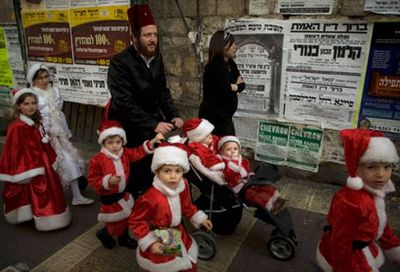
[Purim in Meah Sharim--Haredi style] compliments of Failedmessiah.com.
Now, who says the Haredim don’t have a good sense of humor?
========
Posted by Yochanan Lavie on 28.02.10 at 4:18 pm
‘Twas the night before Purim, when all through the shul
Not a creature was stirring, not even a mule;
The stockings were hung by the ...
The Haman Archetype Lives On
The joke is as old as the hills.
A Chinese man and his Jewish friend were walking along one day when the Jewish man whirled and slugged the Chinese man and knocked him down. “What was that for?” the Chinese man asked. “That was for Pearl Harbor!” the Jewish man said. “Pearl Harbor? That was the Japanese. I’m Chinese.” “Chinese, Japanese, you are all the same!” “Oh!” They continued walking and after a while the Chinese man whirled and knocked the ...
Learn More ShareCategories: Anti-Semitism, Bible, biblical history, biblical theology, Contrarian wisdom, Current Events, ethics, good and evil, Holidays, Interfaith Dialogue, Israel, Jewish and Jungian ideas, Jewish customs, Jewish History, Jewish symbolism, Political Commentaries, The Future of Judaism